
Before this article goes anywhere else, it needs to correct something. If you are searching specifically for “ISB Mohali Management Quota Admission” or “ISB Mohali direct admission” or even “how to apply to ISB Mohali” — you are most likely operating under a misunderstanding that is extremely common, genuinely consequential, and almost never addressed directly in guides like this one.
Here it is: You cannot apply specifically to ISB Mohali.
When you apply to the Indian School of Business, you apply to one institution. ISB is not two separate schools sharing a name. It is a single institution with two campuses — Hyderabad and Mohali — sharing the same faculty, the same curriculum, the same accreditations (AACSB and AMBA), the same admissions process, the same application form, and the same placement process. You submit one application to ISB. The institution’s admissions committee decides which campus you attend.
You can indicate a campus preference. But the final allocation is ISB’s call, not yours.
Understanding this changes your entire approach to ISB Mohali. You don’t “get into ISB Mohali.” You get into ISB — and you may land in Mohali. And whether that’s a disappointment or a deliberate advantage depends entirely on how well you understand what the Mohali campus specifically offers.
Which is what this article is actually about.
On the ISB management quota admission question: There is none. ISB is a private, not-for-profit institution with Triple Crown accreditation. Its Mohali campus does not offer management quota seats, corporate quota seats, donation seats, or any ISB direct admission pathway that bypasses the evaluation process. Any claim to the contrary is false. Now let’s move on to the parts that actually matter.
Also read about: Top MBA Colleges in India
We’re ShikshaLeap. Call us at 9980453099 or write to shikshaleap@gmail.com. ISB applications are essay-intensive and profile-heavy — preparation changes outcomes here more than at most institutions.
ISB Mohali: The Second Campus That Became Something More
The Mohali campus of ISB opened in 2012 — eleven years after the Hyderabad campus established ISB as India’s first globally ranked business school. It was not established as a “junior” campus or a capacity overflow. It was established as a deliberate geographic expansion of ISB’s educational mission into North India.
The location — Knowledge City, Sector 81, SAS Nagar, Mohali, Punjab — sits approximately 10–15 km from Chandigarh city centre, within the Tricity metropolitan region of Chandigarh, Panchkula, and Mohali. Geographically, this makes ISB Mohali the premier management institution serving North India’s most economically active corridor: Punjab’s industrial hubs, Haryana’s manufacturing belt, Chandigarh’s government and professional services economy, and the Tricity’s growing technology sector.
ISB Mohali — Official Campus PageThe campus shares everything with ISB Hyderabad that matters academically: faculty (who teach across both campuses), curriculum (identical across programmes), accreditations (AACSB and AMBA jointly held), admissions process (single application), and placement network (unified recruiter access). If you graduate from ISB Mohali with a PGP, your degree reads “Indian School of Business” — not “ISB Mohali.” Recruiters see the same brand.
What ISB Mohali has built independently — and this is where the campus earns its own conversation — is four specialised research institutes that exist nowhere else in the ISB system, and that give Mohali a sector-specific depth Hyderabad does not replicate.
Also read about: The Best MBA for Entrepreneurs in India
Need Help with Your ISB Mohali Management Quota Admission?
Connect with ShikshaLeap today for expert guidance and personalized assistance to choose the course that best aligns with your career goals.
Call us at: +91-9980453099
Write to us at: shikshaleap@gmail.com
The Four Institutes That Make ISB Mohali Uniquely Itself
This is the part of the ISB Mohali story that gets buried in most admission guides. These institutes are not elective clusters or marketing labels. They are functioning research and teaching bodies with industry partnerships, case libraries, visiting practitioners, and specific career pipeline implications.
Max Institute of Healthcare Management: A dedicated centre for healthcare leadership, established in partnership with Max Healthcare — one of India’s largest hospital networks. The Max Institute at ISB Mohali houses case studies, research, and curriculum modules specifically designed around hospital administration, health systems management, pharmaceutical strategy, and healthcare delivery economics. For PGP students with career interests in healthcare — a sector that is expanding rapidly across hospital systems, MedTech, diagnostics, and health insurance — ISB Mohali’s Max Institute is a specific, differentiated advantage over ISB Hyderabad.
Munjal Institute for Global Manufacturing: Established in association with the Hero Group (Munjal family), this institute focuses on manufacturing excellence, global supply chain management, operations strategy, and industrial leadership. India’s manufacturing ambitions — PLI schemes, Make in India, semiconductor and EV supply chains — are creating a genuine demand for management talent in operations and manufacturing leadership. The Munjal Institute gives ISB Mohali students direct access to case studies, research, and practitioner networks that specifically address this demand.
Punj Lloyd Institute of Infrastructure Management: Infrastructure — roads, ports, airports, energy, real estate development — is one of India’s largest and fastest-growing capital allocation categories. The Punj Lloyd Institute at ISB Mohali provides a research and curriculum anchor for students targeting infrastructure consulting, project finance, and public-private partnership management.
Bharti Institute of Public Policy: A policy research centre that addresses India’s governance, regulation, and public sector management challenges. For PGP students interested in public policy consulting, regulatory roles, development finance, or government advisory careers, the Bharti Institute provides an academic foundation that most private B-schools simply don’t have.
Also read about: Best MBA Colleges in Delhi NCR 2027: Your Gateway to Leadership and Success
These four institutes mean that ISB Mohali, while sharing everything with Hyderabad at the core curriculum level, has sector-specific depth in Healthcare, Manufacturing/Operations, Infrastructure, and Public Policy that the Hyderabad campus does not replicate. If any of these are your target sectors, being allocated to Mohali is not a consolation outcome. It is the better outcome.
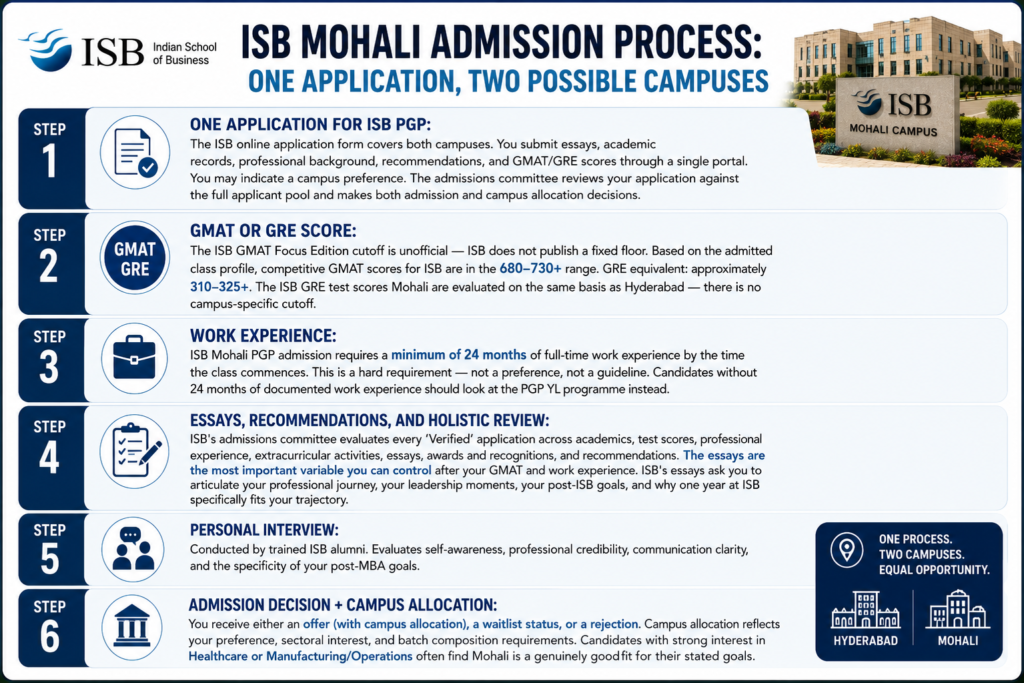
ISB Mohali Admission Process: One Application, Two Possible Campuses
Since ISB is a single institution, the admission process is exactly what we described in our ISB Hyderabad guide — with one important addition: understanding how campus allocation works.
Also read about: NMIMS Mumbai Direct Admission 2027 through Management and NRI Quota
Programmes Offered at ISB Mohali: Everything Available at ISB Mohali
All ISB programmes run at both campuses unless otherwise noted.
| Programme | Duration | Target Profile | Key Admission Requirement |
| PGP | 12 Months | 2+ Years Exp. | GMAT or GRE |
| PGP YL | 20 Months | 0–24 Months Exp. | GMAT, GRE, or CAT (98-99+) |
| PGPpro | 18 Months | 5+ Years Exp. | Profile + Interview (Blended) |
| PGPMAX | 15 Months | 10–25 Years Exp. | Profile + Interview (GMAT optional) |
| PGP MFAB | 15 Months | Family Business | BAT (Business Aptitude Test) |
| AMP Series | Varies | Sector-Specific | Profile + Interview |
Ultimately, ISB Mohali isn’t just a satellite campus; it is a specialized hub designed to bridge the gap between world-class management education and the unique economic landscape of North India. By anchoring sector-specific programmes like the AMP series and providing the blended flexibility of the PGPpro for regional leaders, Mohali caters directly to the operational, policy, and manufacturing requirements of Punjab, Haryana, Himachal Pradesh, and the NCR. Whether you are a family business leader looking to scale through the MFAB or a mid-career professional seeking the prestigious ISB credential without uprooting your life in Delhi or Chandigarh, Mohali offers a tailored academic ecosystem that aligns perfectly with your professional trajectory.
Also read about: ISB Hyderabad Direct Admission 2027: Indian School of Business – The Architecture of Excellence
ISB Mohali vs ISB Hyderabad: The Comparison That Actually Matters
Since most candidates applying to ISB are wondering about this — let’s address it directly rather than diplomatically.
| Parameter | ISB Mohali | ISB Hyderabad |
| Established | 2012 | 2001 |
| Accreditation | AACSB + AMBA (shared) | AACSB + AMBA (shared) |
| FT Global MBA Rank | #27 (shared institution) | #27 (shared institution) |
| Curriculum | Identical | Identical |
| Faculty | Shared across campuses | Shared across campuses |
| Placements | Unified pool | Unified pool |
| Location | Mohali, Punjab (Tricity) | Gachibowli, Hyderabad |
| Corporate Hub Proximity | Tricity, Ludhiana, Amritsar, Delhi NCR | HITEC City, Hyderabad tech cluster |
| Research Institutes | Max (Healthcare), Munjal (Manufacturing), Punj Lloyd (Infrastructure), Bharti (Public Policy) | Different set of centres |
| Alumni Density | Smaller (12 years vs 24 years) | Larger and more established |
| Batch Size | Part of combined ~900 total | Part of combined ~900 total |
The honest reality: the degree is the same. The brand that follows you through your career reads “Indian School of Business.” The campus allocation matters primarily for location preference, sector alignment, and the specific institute exposure you want during the year. Getting into ISB and landing in Mohali is not a lesser outcome. It is a different outcome — and for the right career goals, it is the better one.
Also read about: ISB Hyderabad Direct Admission 2027 – Eligibility | Fees | Placements | Ranking | Management/NRI Quota Guide
Need Help with Your ISB Mohali Management Quota Admission?
Connect with ShikshaLeap today for expert guidance and personalized assistance to choose the course that best aligns with your career goals.
Call us at: +91-9980453099
Write to us at: shikshaleap@gmail.com
ISB Mohali Fees, Scholarships, and the Financial Case
ISB Mohali Fee Structure
Here is the table for ISB Mohali PGP fee structure for the academic year 2027–28 is:
| Programme | Programme Fee | GST | Total Fee (incl. GST) |
| PGP (Flagship) | ₹34,48,000 | 18% | ₹40,68,640 |
| PGP PRO | ₹33,69,559 | 18% | ₹39,76,080 |
| PGP MAX | ₹43,03,508 | 18% | ₹50,78,140 |
| PGP MFAB | ₹44,72,881 | 18% | ₹52,78,000 |
| PGP YL | ₹25,60,000 | 18% | ₹30,20,800 |
Also, a refundable security deposit of ₹20,000 will be applied.
These amount covers admission, commitment, and tuition fees.
The fee payment is structured in installments to facilitate financial planning for students.
Application fee: ₹5,000 (single application covering both campuses and all programmes applied to).
ISB Knowledge City campus hostel fees are built into the accommodation component of the total programme fee. The Mohali campus offers fully residential facilities — both shared and private room options. Meals, learning materials, and certain campus activities are additional.
Scholarships at ISB Mohali
Approximately 25% of each PGP batch at Mohali receives some form of scholarship — a notably higher scholarship coverage than many comparable programmes. Available scholarships include:
| Scholarship Category | Scholarship Name | Eligibility Criteria | Award Details |
| Need-cum-Merit | ISB Need-cum-Merit Waiver | Family income-based; evaluated via essay & income proofs | 75%–100% Tuition Waiver |
| Merit-Based | ISB Merit Waiver | High-performing applicants (automatic consideration) | 25%–100% Tuition Waiver |
| Diversity | Armed Forces Scholarship | Current/former Indian Army, Navy, or Air Force personnel | 50% Tuition Waiver |
| Impact/Social | ISB Develop India Scholarship | Commitment to social enterprise, policy, or impact sectors | Varies |
| Diversity | Women in Leadership | Female candidates in male-dominated industries | Varies (e.g., 50% for Manasa Mandava) |
| Diversity | ISB Merit by Diversity | Diverse professional or educational background | 25%–100% Tuition Waiver |
ROI of ISB Mohali
At ₹38–42 lakhs and average placement outcomes in the ₹32–35 LPA range (ISB combined), the payback period for an average earner is approximately 14–16 months post-graduation. For the top quartile (₹50+ LPA range), payback is under 12 months. For a one-year programme, this positions ISB — both campuses — among the strongest ROI management programmes in India.
Also read about: Masters’ Union Gurgaon Management Quota Admission: The School That Doesn’t Fit the Template
ISB Mohali Placement Story: One Pool, Sector Depth in Two Directions
ISB’s integrated placement process — described in detail in our ISB Hyderabad article — runs as a unified process across both campuses. Recruiters access the full ISB cohort simultaneously. There is no Hyderabad-first or Mohali-secondary ordering.
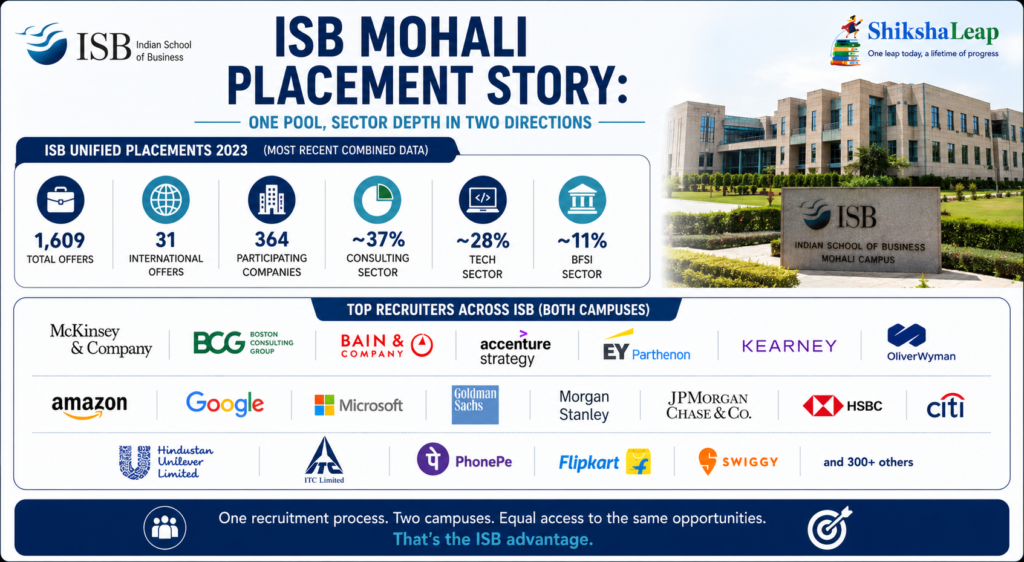
ISB Mohali-specific placement strength: The four research institutes create specific recruiter pipelines that function differently at Mohali than at Hyderabad. Healthcare companies — Max, Apollo, Fortis, Manipal, Medanta — recruit at ISB Mohali specifically through the Max Institute. Manufacturing conglomerates — Hero Group, UltraTech, Havells, Motherson Sumi, and large MSME exporters — recruit at Mohali through the Munjal Institute connection. Infrastructure firms and consulting companies in the PLI/infra space are similarly more active at Mohali given the Punj Lloyd Institute’s relationships.
ISB Mohali product management and operations placements are a growing strength — reflecting both the Munjal Institute’s manufacturing focus and the broader ISB tech recruiting network reaching the Mohali campus.
Also read about: MDI Gurgaon Management Quota Admission: Three Questions, Three Honest Answers, One Definitive Guide
Need Help with Your ISB Mohali Management Quota Admission?
Connect with ShikshaLeap today for expert guidance and personalized assistance to choose the course that best aligns with your career goals.
Call us at: +91-9980453099
Write to us at: shikshaleap@gmail.com
How ShikshaLeap Supports ISB Mohali PGP Applications?
Whether you want Mohali for its sector institutes, its North India location, or you simply want ISB and are comfortable with either campus — the application you submit is identical. And the quality of that application determines whether you get in at all.
- GMAT / GRE Strategy for ISB-Level Profiles
- ISB Mohali Application Essay Review Services
- ShikshaLeap ISB Application Strategy
- Interview Preparation Timeline and Coaching
- PGP YL Application Strategy
- PGPpro Chandigarh/Mohali Guidance
📞 Call ShikshaLeap at 9980453099 ✉️ Write to us at shikshaleap@gmail.com One ISB application serves both campuses. Make it the best application you can build. ShikshaLeap — One Leap Today. A Lifetime of Progress.
ISB Mohali Management Quota Admission: The Closing Case
There is no management quota at ISB Mohali. There is no direct admission. There are no donation seats. These answers are the same as for ISB Hyderabad — because ISB Mohali is not a separate institution. It is a campus of the same school.
But it is a campus with a specific identity — the Max Institute, the Munjal Institute, the Bharti Institute, the Punj Lloyd Institute — that positions it as the right choice for a specific set of career goals. Healthcare leadership, manufacturing strategy, infrastructure consulting, public policy — these are careers that ISB Mohali is specifically set up to serve, through research institutes that no other campus of ISB replicates.
If you are in North India and want an ISB degree without relocating to Hyderabad — Mohali is your answer. If your career is in Healthcare or Manufacturing or Operations — Mohali is, specifically, the better campus.
One application. One ISB. Two campuses. Choose to be clear about which one fits your goals — and then apply like that clarity is your strongest asset.
➡️ Start your ISB Mohali journey with confidence — Let ShikshaLeap guide you every step of the way!
ShikshaLeap wishes each and every Aspirant, best of Luck for your Journey! You already won the day to decide to go for it so let not anything stop you from achieving your goal and if you have any doubt regarding anything maybe it is the entrance exam, interview prep or profile building we are there as your Friend, Philosopher & Guide!
Let’s TALK @ 9980453099
FAQs About ISB Mohali PGP Management Quota Admission
Q1. Can I apply specifically to ISB Mohali?
No. ISB is a single institution with one application process. You apply to ISB — the admissions committee decides campus allocation. You can indicate a preference and make a case for why Mohali fits your goals.
Q2. Is there a management quota at ISB Mohali?
No. ISB Mohali does not have management quota, donation seats, or any payment-based admission pathway. The only route is through GMAT/GRE + work experience + essays + Personal Interview.
Q3. What is the GMAT cutoff for ISB Mohali?
ISB does not publish a fixed cutoff however, both campuses use the same admissions standard.
Q4. What is the minimum work experience for ISB Mohali PGP?
24 months of full-time work experience by class commencement date. This is a hard requirement for PGP. PGP YL is designed for candidates with 0–24 months of work experience.
Q5. Is YLP still available at ISB Mohali?
No. The YLP (Young Leaders Programme) and EEO (Early Entry Option) have been officially discontinued. They have been replaced by the PGP YL — a direct 20-month programme for candidates with 0–24 months of work experience.
Q6. What makes ISB Mohali different from ISB Hyderabad?
The four specialised institutes: Max Institute of Healthcare Management, Munjal Institute for Global Manufacturing, Punj Lloyd Institute of Infrastructure Management, and Bharti Institute of Public Policy. These are unique to Mohali and provide sector-specific depth in Healthcare, Manufacturing, Infrastructure, and Public Policy that Hyderabad does not replicate.
Q7. What scholarships are available at ISB Mohali?
Approximately 25% of the PGP batch receives some scholarship. Available options include: Need-cum-Merit, Merit-based (up to 100% waiver), Defence Scholarship, ISB Develop India Scholarship, and Women in Leadership Scholarship. Details are updated on isb.edu each cycle.
Q8. Are ISB Mohali placements the same as ISB Hyderabad?
Yes — ISB runs an integrated, unified placement process across both campuses. Recruiters access the full ISB cohort simultaneously. The ISB degree does not mention campus. Placement outcomes are reported at the ISB level, not campus level. Mohali has sector-specific strength in Healthcare, Manufacturing, and Operations through its research institutes.
Also Read About:
- XLRI PGDM Management Quota Admission — Everything You Actually Need to Know Before You Apply
- ISB Hyderabad Management Quota Admission: What the FT’s #27 School in the World Actually Wants From You
- SP Jain Mumbai Management Quota Admission: What Nobody Tells You About Getting Into SPJIMR Mumbai
- NMIMS Mumbai Management Quota Admission: The Unfiltered Guide Nobody Else Will Give You
- BITSoM Mumbai Management Quota Admission: The 60-Year Brand, the 4-Year School, and the Decision Nobody’s Talking About Clearly
If you’re planning to pursue Engineering and want to explore top Engineering colleges, courses, and admission options, Visit: Direct Admission to Top Private Engineering Colleges in India | Shiksha Tech
OR
If you’re planning to pursue MBBS and want to explore Top MBBS Colleges, courses, and admission options, Visit: Direct Admission to Top Medical Colleges in India | Dr. Shiksha