
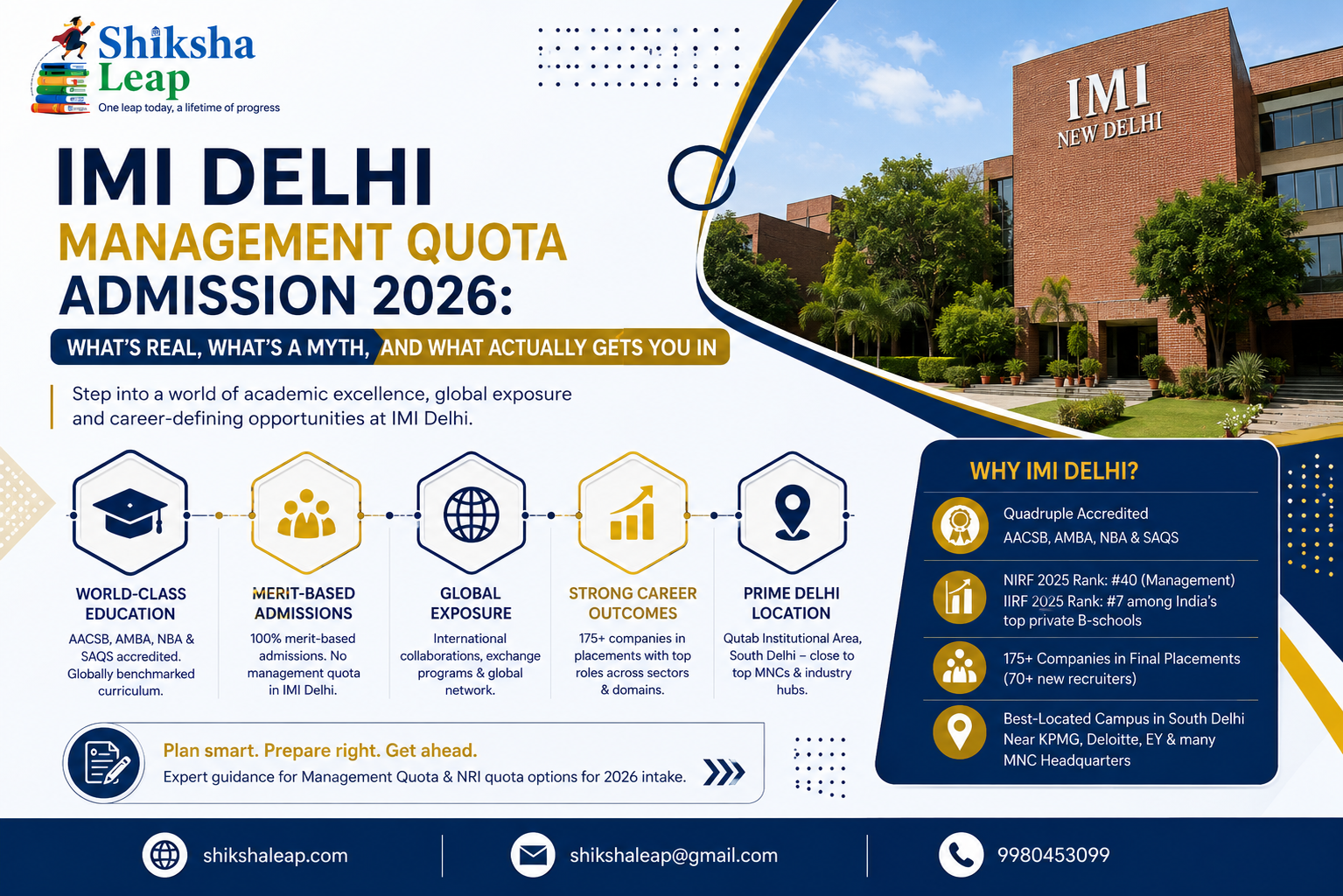
If you’re reading this, you’ve probably spent the last hour going down a rabbit hole. You’ve seen the IMI Delhi PGDM brochure, liked what you saw, and then somewhere between checking CAT cutoffs and budget planning, stumbled into a part of the internet where consultants promise “guaranteed seats” and “direct admission through management quota at IMI Delhi” for the right fee.
Here’s the thing — some of that content is written by people who are genuinely trying to help. And some of it is written by people who would genuinely like your money. The problem is they look exactly the same online.
So, before you call any of those numbers or fill out any of those forms, read this first. We’re going to settle the management quota question definitively, show you what the actual IMI Delhi admission process looks like, and — more importantly — show you why a well-prepared candidate has a far better shot at IMI Delhi than most people think.
We’re ShikshaLeap. We help students get into top B-schools through strategy, preparation, and honest guidance. Not shortcuts. And if by the end of this article you want to talk — about your profile, your CAT score, your timeline — we’re one call away at 9980453099 or shikshaleap@gmail.com.
The IMI Delhi Management Quota Admission Conversation — Let’s Have It Properly
Type “IMI Delhi management quota admission 2027” into any search engine and you’ll find two types of results: articles that flatly say it doesn’t exist, and consultants who say it does. Who’s right?
Here’s the accurate, nuanced answer.
IMI Delhi does not have an officially declared management quota in the way that some state-run or private universities do under AICTE’s management seat allocation framework. The institute does not publicly offer or advertise payment-based seats. Its official admissions process — governed by the IMI Delhi Admissions Committee — is strictly based on entrance exam scores, academic record, and performance in the Individual Assessment Process.
What does exist is a distinction between self-sponsored and company-sponsored candidates. Company-sponsored candidates — those supported by a PSU or business house — can be given elevated consideration during shortlisting on the basis of their sponsoring organisation’s recommendation. This is a formal, disclosed process. It’s not a quota. It’s a category.
The Best MBA for Entrepreneurs in India
Beyond that? Anyone promising you a “confirmed seat” at IMI Delhi for a fixed consultancy fee is operating independently of the institute’s official process. The risk to you — of losing money, wasting a year, or getting tangled in something ethically questionable — is not worth it.
The real path into IMI Delhi is cleaner, more predictable, and more achievable than most applicants realise. Let’s walk through it.
Need Help with Your IMI Delhi Management Quota Admission?
Connect with ShikshaLeap today for expert guidance and personalized assistance to choose the course that best aligns with your career goals.
Call us at: +91-9980453099
Write to us at: shikshaleap@gmail.com
Why IMI Delhi Is Still Worth the Effort in 2027
Before we get into process, a word on why this institute deserves serious attention in the first place.
International Management Institute, New Delhi was established in 1981 — making it one of the oldest private B-schools in India. What makes its origin story genuinely interesting is who founded it: RPG Enterprises, ITC, Nestlé, Tata Chemicals, British Oxygen, and SAIL — in collaboration with IMD Lausanne, Switzerland (then IMI Geneva). This isn’t a college that grew out of a trust or a real estate group. It was built by India’s top corporations to train managers they actually wanted to hire. That DNA is still visible in how IMI runs its curriculum and industry engagement today.
Best MBA Colleges in Delhi NCR 2027: Your Gateway to Leadership and Success
Fast forward to 2027, and IMI Delhi holds:
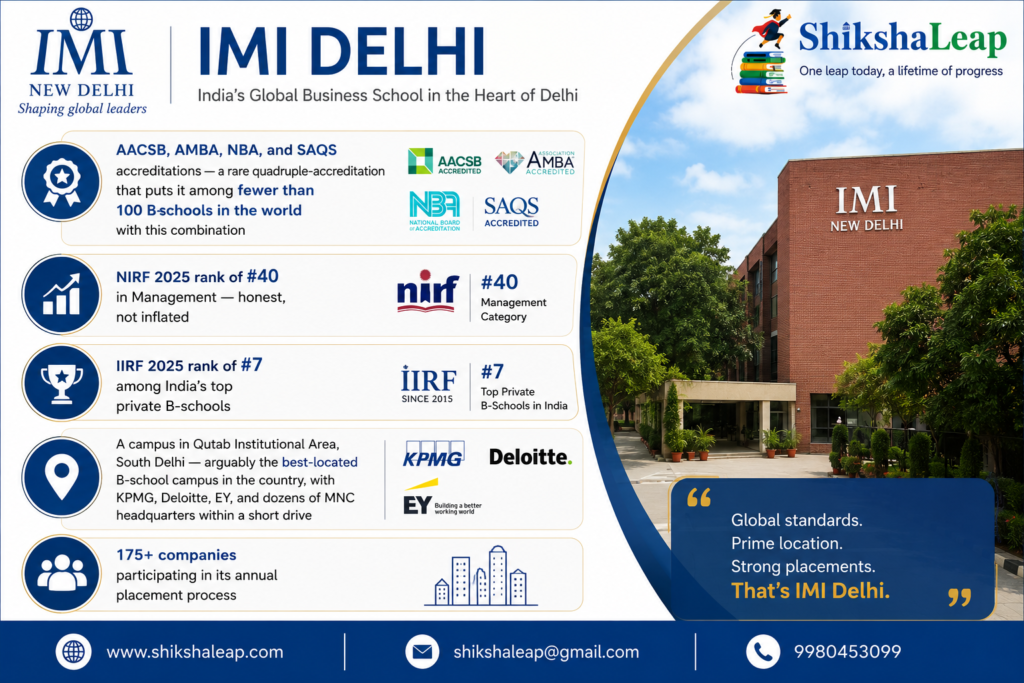
None of these are numbers you build by offering management quota seats to underqualified students. They’re built by consistently producing managers that industry trusts.
Programmes Offered at IMI Delhi: Which One Is Actually Right for You?
This question matters more than most applicants realise at the application stage. IMI Delhi offers a genuinely varied portfolio, and picking the right programme can change both your shortlisting odds and your career trajectory.
PGDM (General Management): The flagship two-year programme. Divided across six semesters with seven available specialisations: Marketing, Finance, Analytics, Human Resource Management, Operations, Banking & Financial Services, and Strategy. This is IMI Delhi’s broadest programme and its biggest batch. If you’re not yet certain about specialisation depth, this is your starting point.
PGDM (HRM): Two years, specifically structured for candidates who want to build careers in HR leadership, talent strategy, OD, and consulting. IMI Delhi’s HRM programme has a strong track record with HR roles at conglomerates, FMCG majors, and consulting firms. In the 2027 placements, PGDM HRM recorded an average of ₹16.32 LPA.
Is IIFT Delhi Direct Admission 2027 Possible?
- PGDM (B&FS): Two years, focused exclusively on Banking and Financial Services. This is IMI Delhi’s highest-performing programme by salary outcomes — the 2026 batch recorded an average of ₹16.60 LPA and a highest of ₹29.25 LPA. If BFSI is your target sector, this programme deserves serious consideration over the general PGDM.
- PGDM (18-Month Executive): For working professionals with a minimum of three years of post-qualification experience. Same rigour, compressed timeline, designed around the constraints of a career break. Fee: approximately ₹14.96 lakhs. This is worth a separate conversation if you’re an experienced candidate.
- FPM (Fellow Programme in Management): IMI Delhi’s doctoral-equivalent programme across seven research areas including Finance, Marketing, OB/HRM, Operations, Strategy, Economics, and Information Management. Different conversation entirely — but relevant for candidates considering academia or research-based roles.
The IMI Delhi Eligibility Criteria Bar: Lower Than You Think, Harder Than It Sounds
On paper, IMI Delhi’s eligibility criteria are very accessible:
- Any bachelor’s degree with minimum 50% aggregate from a recognised university
- Valid score in CAT, XAT, or GMAT are accepted
- Final-year students may apply, provided degree completion evidence is submitted on time
No specific branch, no specific graduation percentage beyond 50%, no mandatory work experience for the two-year PGDM. That’s the good news.
Is IMI Delhi Direct Admission possible in 2027?
The more nuanced reality: what you need to get in is a different question from what you need to be eligible. IMI Delhi receives applications from thousands of candidates every year who meet the minimum eligibility. The actual selection is where things get interesting.
Need Help with Your IMI Delhi Management Quota Admission?
Connect with ShikshaLeap today for expert guidance and personalized assistance to choose the course that best aligns with your career goals.
Call us at: +91-9980453099
Write to us at: shikshaleap@gmail.com
CAT Cutoff, XAT Cutoff, GMAT: The Numbers That Actually Matter
IMI Delhi does not publish a rigid, programme-specific cutoff table the way some institutes do. What it publishes is a composite evaluation framework — but based on historical data and applicant trends, here’s a realistic picture of where you need to be:
| Exam | General Category | OBC/Women/Diversity | GMAT |
| CAT 2026 | 90–95 percentile | 85–90 percentile | — |
| XAT 2027 | 85–92 percentile | 80–87 percentile | — |
| GMAT | — | — | 635+ |
A few things to note about these numbers. First, IMI Delhi does not impose sectional cutoffs — so a strong overall score without a dramatically weak section is what you’re targeting, not a specific VARC or DILR benchmark. Second, the composite score that drives shortlisting isn’t just the exam score — academic record, quality of work experience, and extracurricular achievements all factor in. A 91 percentile candidate with a consistently strong academic record and one year of solid work experience has genuinely competed for and won an IMI Delhi seat.
How to get Direct Admission in LBSIM Delhi 2027?
Third – and this is specific to IMI Delhi’s process – the GMAT route is taken seriously here, including for NRI and international candidates. NRI applicants go through the same Individual Assessment Process as domestic candidates. NRI/FN programme fees for 2027–29 stand at 26,720 USD.
IMI Delhi Admission Selection Process: How IMI Delhi Actually Selects You?
This is the part of the IMI Delhi admission process that most people understand least — and where most of the preparation should actually go. After shortlisting based on exam scores and academic profile, IMI Delhi runs what it calls the Individual Assessment Process. It has two stages:
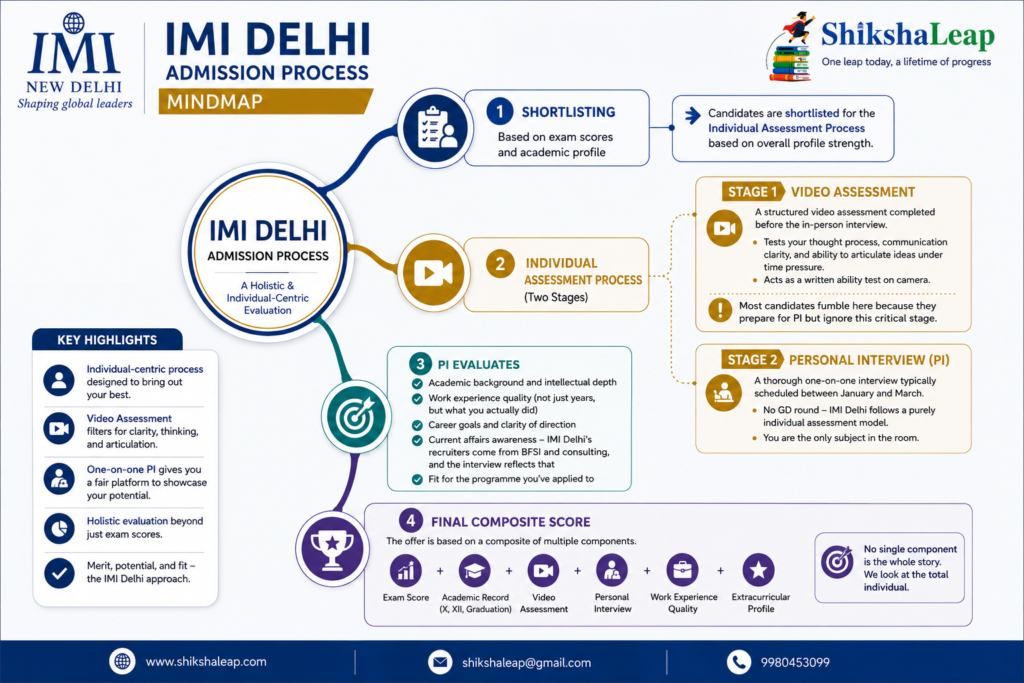
This is exactly why we say to every IMI Delhi applicant at ShikshaLeap: your CAT score opens the door. Your Individual Assessment is what decides whether you walk through it.
How to get Direct Admission in FORE Delhi through Management Quota and NRI Quota?
The Financial Picture: Fees, Scholarships, and the Loan Option
Let’s talk money — clearly and without sugarcoating.
IMI Delhi PGDM Fees (2027–29 Batch)
| Component | Amount |
| Total Programme Fee (self-sponsored) | ₹23.54 Lakhs |
| NRI Programme Fee | 26,720 USD |
| Hostel (twin sharing, attached bath, 2 years) | ~₹4.10 Lakhs |
| Hostel (twin sharing, common bath, 2 years) | ~₹3.20 Lakhs |
| Application Fee | ₹2,000 + 18% GST |
Fees are paid across six instalments beginning from acceptance. The full amount does not need to be arranged upfront, which makes the financial planning more manageable than it looks on paper.
On loans: IMI Delhi has tie-ups with SBI and HDFC Bank offering up to 100% education loan financing at competitive rates. SBI’s loan terms for IMI Delhi are favourable, and the institute’s placement record makes lenders comfortable with the application.
Admission in Faculty of Management Studies (FMS) Delhi 2027
Now, the scholarship question — because this is where many students don’t realise what’s available to them.
IMI Delhi offers two internal scholarship tracks
- IMI Academic Excellence Scholarship: Up to 8 students can receive a 100% tuition fee waiver. Up to 15 students can receive a 50% tuition fee waiver. Awarded based on academic performance and overall composite score at admission.
- IMI Professional Impact Scholarship: Up to 4 students can receive a 100% tuition fee waiver. Up to 6 students can receive a 50% tuition fee waiver. Awarded based on demonstrated professional impact, leadership, and social contribution.
Beyond these two, AICTE’s Tuition Fee Waiver scheme is available to economically weaker students (family income below ₹8 lakh/year), and external corporate scholarships from groups like Tata and Aditya Birla are accessible to IMI Delhi students.
The practical reality: approximately 5% of each batch receives some form of financial assistance. If you’re applying and your profile is strong, mention your financial situation explicitly during the process — it doesn’t hurt and it might help.
At ShikshaLeap, we help you evaluate whether you’re a realistic scholarship candidate before you apply, so you can make a financially informed decision about IMI Delhi versus other target colleges. Call us at 9980453099 and we’ll walk through the numbers with you honestly.
MDI Gurgaon Direct Admission 2027: Is Management Quota an Option?
Need Help with Your IMI Delhi Management Quota Admission?
Connect with ShikshaLeap today for expert guidance and personalized assistance to choose the course that best aligns with your career goals.
Call us at: +91-9980453099
Write to us at: shikshaleap@gmail.com
IMI Delhi Placement Report: What the Placements Actually Look Like — Without the Spin
Let’s be straight about IMI Delhi placements, because there’s a version of this data that gets presented in a misleading way and you deserve the accurate picture. IMI Delhi Final Placements 2026 (2024 – 2026 Batch):
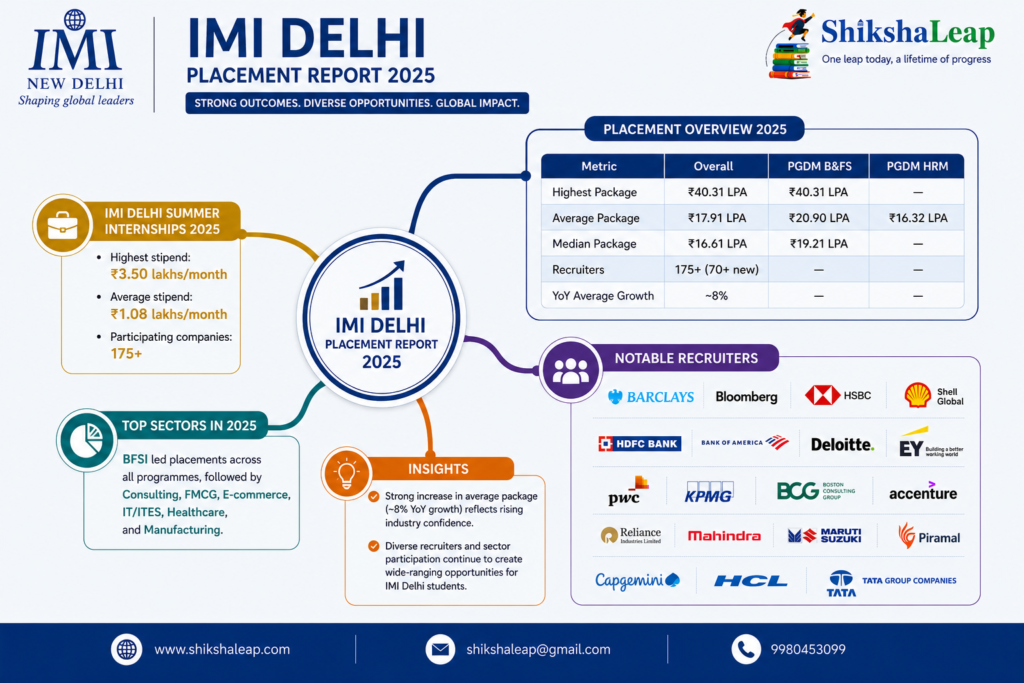
For the right candidate targeting BFSI, Consulting, or Delhi-NCR-based roles, the ROI of IMI Delhi is strong and the path in is genuinely achievable with the right preparation.
IMI Delhi vs FORE vs IMT Ghaziabad: Where Does It Actually Sit?
Since we’re being honest, let’s also address the comparison question most IMI Delhi aspirants are quietly running in their heads.
| Parameter | IMI Delhi | FORE Delhi | IMT Ghaziabad |
| NIRF 2026 | #40 | ~#44 | ~#30 |
| Accreditations | AACSB, AMBA, NBA, SAQS | AMBA, NBA | AACSB, AMBA |
| CAT Cutoff | 90–95%ile | 85–90%ile | 85–90%ile |
| Average Package 2026 | ₹17.91 LPA | ~₹14–16 LPA | ~₹13–15 LPA |
| Location Advantage | South Delhi | South Delhi | Ghaziabad |
| BFSI Strength | Very Strong | Moderate | Moderate |
| Consulting Depth | Strong | Moderate | Moderate |
ShikshaLeap’s honest read: If you have a 90–95 percentile CAT and a Delhi-NCR preference, IMI Delhi is the stronger choice over FORE and IMT Ghaziabad — for salary outcomes, accreditation depth, and sector-specific recruiter quality. If you’re getting calls from both IMI Delhi and MDI Gurgaon, that’s a conversation we should have in detail because the right answer depends on your target sector and whether you’re aiming for an HR, Finance, or Marketing track.
IMT Ghaziabad Admission 2027: Cutoffs, Fees, Placements & Direct Admission
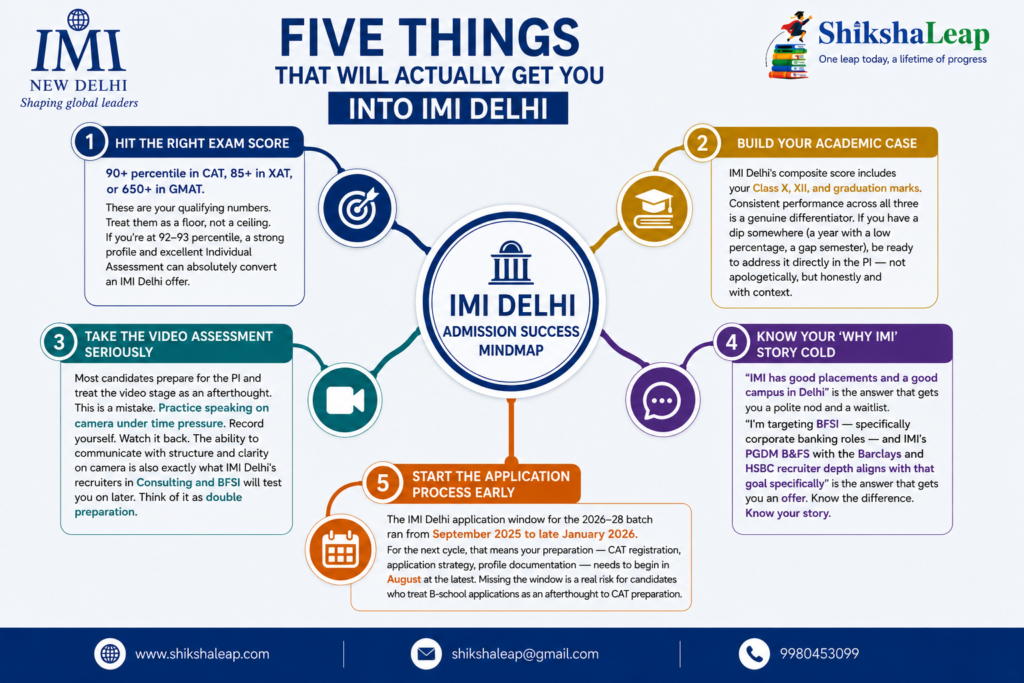
Five Things That Will Actually Get You Into IMI Delhi
By this point, you’ve probably figured out that management quota isn’t your path in. Here’s what actually is:
Need Help with Your IMI Delhi Management Quota Admission?
Connect with ShikshaLeap today for expert guidance and personalized assistance to choose the course that best aligns with your career goals.
Call us at: +91-9980453099
Write to us at: shikshaleap@gmail.com
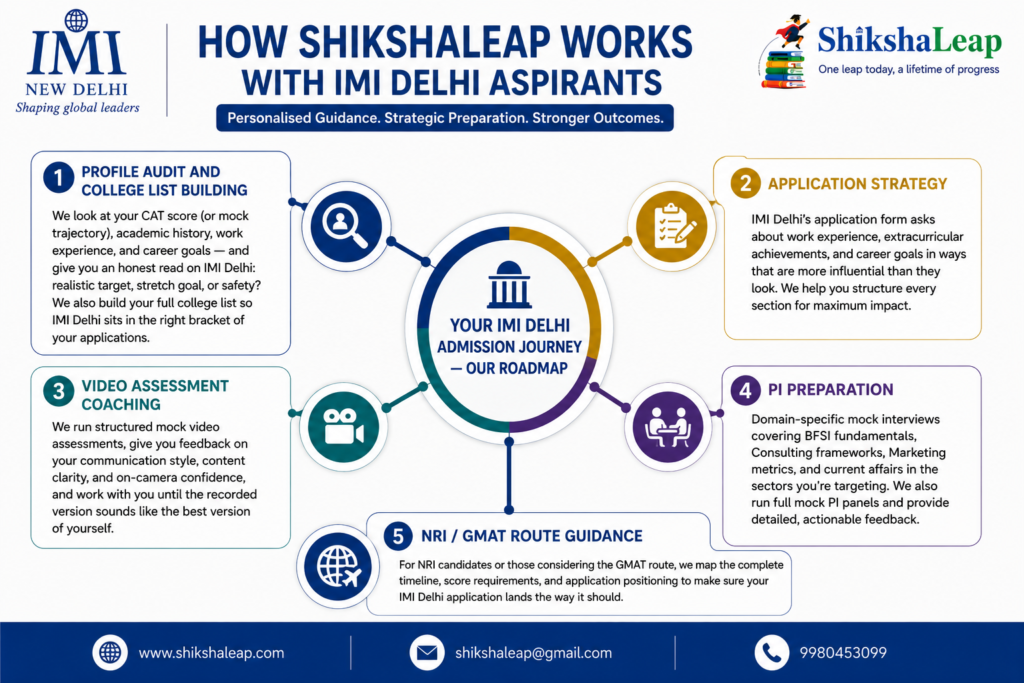
How ShikshaLeap Works With IMI Delhi Aspirants
We don’t promise seats. We don’t have “relationships” with admissions offices. What we do have is a structured, transparent preparation system that has helped candidates from varying profile types convert IMI Delhi offers — and more importantly, understand clearly which IMI Delhi programme suits them and whether it’s the right fit given their overall college list.
Here’s what working with ShikshaLeap on your IMI Delhi application looks like:
Is IMI Delhi the right option for you?
IMI Delhi management quota admission 2027 is not a viable path. It wasn’t a viable path in 2027 either. The institute’s merit-based process — CAT/XAT/GMAT, Video Assessment, Personal Interview, composite scoring — is how every seat in the 2027 – 2029 batch will be filled.
But here’s what we want you to take away: IMI Delhi is not an impossible target. A 90–93 percentile CAT score, a consistent academic record, a well-structured application, and a sharp Individual Assessment performance — that combination gets people into IMI Delhi every year. People who didn’t top their class. People who aren’t engineers. People who had one bad semester and had a good story to tell about it.
The difference between those who convert and those who don’t isn’t talent. It’s preparation and strategic clarity.
If you want both, let’s talk.
📞 Call ShikshaLeap at 9980453099 ✉️ Write to us at shikshaleap@gmail.com One honest conversation today could change which campus you’re walking onto in July 2027. ShikshaLeap — One Leap Today. A Lifetime of Progress.
➡️ Start your IMI Delhi journey with confidence — Let ShikshaLeap guide you every step of the way!
ShikshaLeap wishes each and every Aspirant, best of Luck for your Journey! You already won the day to decide to go for it so let not anything stop you from achieving your goal and if you have any doubt regarding anything maybe it is the entrance exam, interview prep or profile building we are there as your Friend, Philosopher & Guide!
Let’s TALK @ 9980453099
FAQs About IMI Delhi PGDM Direct Admission
Q. Does IMI Delhi have a management quota?
No officially declared management quota exists at IMI Delhi. Admission is entirely merit-based through CAT/XAT/GMAT and the Individual Assessment Process.
Q. Can I get direct admission in IMI Delhi without CAT?
Only if you use a valid GMAT score (from January 2022 to January 2027). XAT is also accepted. For Indian nationals, CAT or XAT is the standard route.
Q. What is the exact total fee for IMI Delhi PGDM 2027–29?
The total academic fee for the 2027–29 batch will be released in March 2027 around ₹23.54 lakhs. Hostel charges are additional (₹3.20 – 4.10 lakhs for two years, depending on room type).
Q. Does IMI Delhi consider work experience in admissions?
Yes. Work experience quality (not just duration) adds meaningful weight to the composite score and is discussed in the PI. Freshers are also considered and regularly admitted.
Q. How accessible are IMI Delhi scholarships?
The Academic Excellence and Professional Impact scholarships together cover up to 37 students per batch with full or half tuition waivers. That’s a meaningful number. Apply well, perform well in the PI, and these are realistic — not just theoretical.
Q. How does IMI Delhi compare with MDI Gurgaon or SPJIMR Mumbai?
IMI Delhi has a more accessible CAT cutoff (90–95 vs 96–97 for MDI, 85–97 for SPJIMR depending on route). Average placement outcomes are lower than both, but the PGDM B&FS programme specifically delivers competitive BFSI outcomes. The South Delhi location is a genuine career advantage for Delhi-NCR-focused candidates.
Also read about:
- SCMHRD Pune MBA Direct Admission 2027: Eligibility, Fees, Placements & How to Secure a Seat
- ISB Hyderabad Direct Admission 2027: Indian School of Business – The Architecture of Excellence
- MDI Gurgaon Direct Admission 2027: Is Management Quota an Option?
- SP Jain Mumbai Direct Admission 2027: Exploring Management & NRI Quota Paths
- XLRI Delhi Management Quota Admission 2027: Let’s Have the Honest Conversation Nobody Else Will
If you’re planning to pursue Engineering and want to explore top Engineering colleges, courses, and admission options, Visit: Direct Admission to Top Private Engineering Colleges in India | Shiksha Tech
OR
If you’re planning to pursue MBBS and want to explore Top MBBS Colleges, courses, and admission options, Visit: Direct Admission to Top Medical Colleges in India | Dr. Shiksha