

Let’s be straight with you. If you’ve been Googling “XLRI PGDM Management Quota Admission” at 1 AM, chances are you either not well prepared for the XAT exam, or you’re someone who believes their profile deserves a shot at this college regardless of one exam’s outcome. Both are valid. And honestly, both are more common than you’d think.
XLRI Jamshedpur / Delhi-NCR — both campuses carry one of the most respected names in Indian management education — does offer avenues beyond the standard merit route. But there’s a lot of noise online about what “XLRI Delhi management quota”, “XLRI Delhi direct admission”, “XLRI Jamshedpur management quota” or “XLRI Jamshedpur direct admission” actually means here, and most of it is either vague or outright misleading. So, let’s break this down properly.
First, What Makes XLRI Jamshedpur / Delhi-NCR Worth This Conversation?
Before getting into the admission mechanics, it’s worth asking: why XLRI Delhi or Jamshedpur in the first place?
XLRI as an institution has a 75+ year legacy. The Delhi-NCR campus, though newer compared to the Jamshedpur mothership, has quickly built a strong identity of its own — particularly for students who want to be in the country’s commercial capital rather than a quieter industrial town. Delhi’s ecosystem means easier access to corporate networks, weekend industry interactions, alumni meets, and internship pipelines with companies headquartered in Gurugram and Noida.
For the PGDM-BM (Business Management) and PGDM-IEV (Innovation, Entrepreneurship & Venture) programmes, the Delhi campus gives you the XLRI brand with a sharp focus on emerging business realities. If you’re someone who sees themselves in consulting, strategy, or starting something of their own — this combination is hard to beat among the top management colleges in Delhi-NCR.
The Best MBA for Entrepreneurs in India
XLRI Delhi PGDM Admission — The Standard Route First
To understand where management quota fits in, you need to first know how the regular process works.
XAT is the primary gateway. XLRI Delhi runs its admissions almost entirely through XAT scores — a test that’s known for being one of the tougher management entrance exams in the country, largely because of its decision-making and verbal reasoning sections.
For XLRI Delhi-NCR XAT cutoff 2027, expect the following rough benchmarks (these shift slightly each year based on test difficulty and applicant pool):
- PGDM-BM: Around 92-95 percentile for calls, with final selection typically at 93+
- PGDM-IEV: Slightly more holistic, with some weight given to entrepreneurial experience
The XAT percentile for XLRI Delhi call isn’t fixed in stone, but anything below 90 makes it very difficult to get a shortlist through the standard process. This is exactly the point where many candidates start exploring other doors — and rightly so.
Need Help with Your XLRI PGDM Management Quota Admission?
Connect with ShikshaLeap today for expert guidance and personalized assistance to choose the course that best aligns with your career goals.
Call us at: +91-9980453099
Write to us at: shikshaleap@gmail.com
So What Is Management Quota Admission at XLRI Delhi, Really?
Here’s where you need to separate fact from wishful thinking.
XLRI Delhi Management Quota Admission 2027: Let’s Have the Honest Conversation Nobody Else Will
XLRI Delhi, like most top private B-schools, reserves a portion of its seats under categories that aren’t purely merit-based XAT scores. These include:
Corporate Quota / Sponsored Seats: Many companies — especially large corporates and family businesses — have arrangements where they can sponsor candidates for admission. If you’re being sent by your employer, the weight given to work experience, organisational backing, and professional achievements can sometimes outweigh a slightly lower XAT score. XLRI Delhi corporate quota seats are genuinely valued by the institute because sponsored students often bring real-world gravitas into classrooms.
XLRI Delhi NRI Quota: For candidates who are non-resident Indians or hold foreign nationality, XLRI Delhi has an NRI quota admission pathway. The admission criteria here typically involve GMAT scores (often 655+) rather than XAT, along with academic background and interviews. NRI quota fee structures are different and generally higher than the domestic fee.
XLRI Delhi Direct Admission: This is the category that gets talked about the most — and misunderstood the most. XLRI Delhi direct admission isn’t a backdoor; it’s a process where exceptional profiles (exceptional academic record, significant work experience, notable achievements) may get considered even if their XAT percentile fell slightly short. This is not a guarantee, and it certainly isn’t something you can “buy” — but it is real, and the right guidance can help you present your profile in a way that makes it a genuine option.
XLRI Delhi Direct Admission 2027 – Cutoff | Fees | Placements | Ranking | Quota Seats
XLRI Delhi PGDM-BM Fees — Know What You’re Committing To
Money matters. Let’s not skip this.
The XLRI Delhi PGDM-BM fees are approximately ₹30 lakhs for the full two-year programme (this includes tuition fees; the exact figure gets updated annually so always verify from the official XLRI website). For NRI quota students, the fee can be considerably higher.
XLRI Delhi hostel fees are charged separately and typically range between ₹1.5–2.5 lakhs per year depending on the room type and facilities. The Delhi-NCR campus has well-maintained hostels, and most students choose to stay on campus, especially in the first year.
Add to this living expenses, books, study trips, and club activities, and you’re realistically looking at a total investment of close to ₹35 lakhs for the full programme. That sounds like a lot — until you look at what comes out on the other side.
Best MBA Colleges in Delhi NCR 2027: Your Gateway to Leadership and Success
XLRI Delhi PGDM-IEV Admission — Is It Right for You?
A word specifically about the XLRI Delhi PGDM-IEV admission process, because this programme often gets overlooked in favour of BM.
IEV (Innovation, Entrepreneurship and Ventures) is a fascinating programme for the right kind of person — someone who has a business idea they want to develop, someone coming from a family business background who wants structured knowledge, or a professional who wants to transition into the startup ecosystem.
The admission process for IEV still runs through XAT, but the interview panels give significantly more weight to entrepreneurial thinking, previous ventures (even failed ones), and a demonstrated curiosity about business creation. If you’ve ever built something — even informally — this is the programme where that story matters.
Is IIFT Delhi Direct Admission 2027 Possible? | Admission, Cutoff, Fees & Placements Guide
Need Help with Your XLRI PGDM Management Quota Admission?
Connect with ShikshaLeap today for expert guidance and personalized assistance to choose the course that best aligns with your career goals.
Call us at: +91-9980453099
Write to us at: shikshaleap@gmail.com
XLRI Delhi Placement Picture: Where Does XLRI Delhi Actually Land?
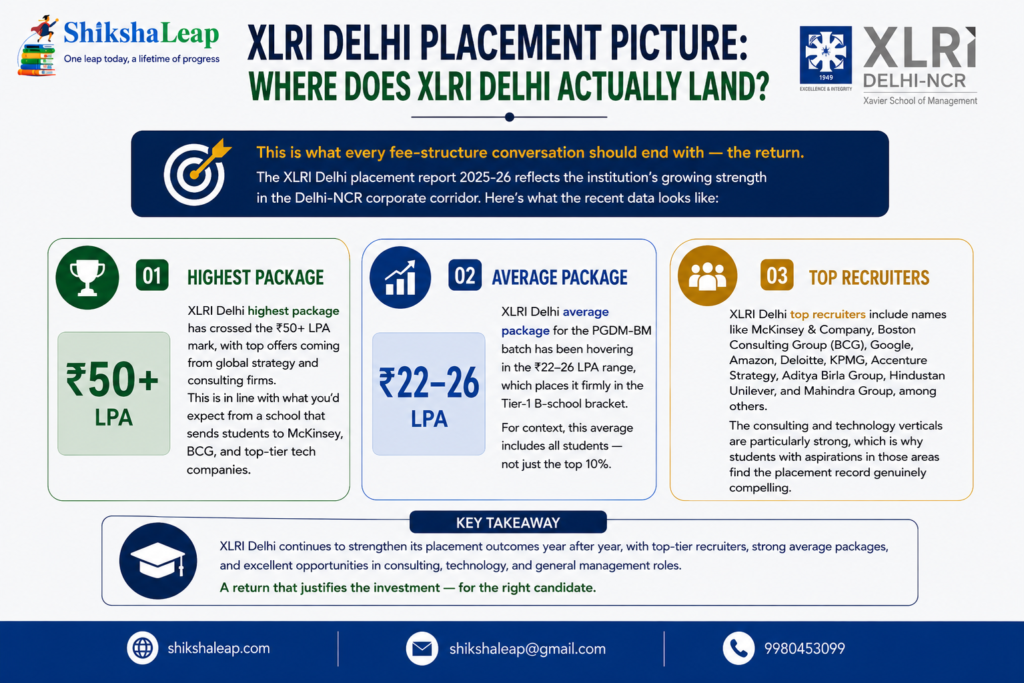
For PGDM-IEV students, the placement profile looks a bit different — some opt for VC-funded startups, some go into family businesses with a new toolkit, and some join innovation divisions of large corporations. The programme is built for people who want to colour outside the lines.
Is IMI Delhi Direct Admission possible in 2027?
Why ShikshaLeap Guidance Actually Matters for XLRI PGDM Management Quota Admission?
Here’s something that often gets overlooked: XLRI Delhi admission isn’t just about meeting a cutoff. It’s about how you present yourself — in your application essays, in your GD, in your personal interview. Two candidates with identical XAT scores can have completely different outcomes based on how well they’ve structured their story.
This is where ShikshaLeap comes in.
If you’re looking for XLRI Delhi admission guidance, ShikshaLeap has spent years helping students navigate exactly this terrain. The team understands not just the numbers game — XAT percentiles, application forms, fee structures — but the qualitative side of it too. Essay framing, profile positioning, interview preparation, and yes, navigating the management quota and direct admission routes where they’re legitimately applicable.
For students who are trying to secure an XLRI Delhi seat but aren’t sure whether their profile fits the standard route, working with a team that has actual institutional knowledge — not just generic MBA coaching — makes a concrete difference.
XLRI Delhi Direct Admission 2027: Where Innovation Meets Intensity
ShikshaLeap as an XLRI Delhi admission consultant in Delhi-NCR brings a few things that generic coaching doesn’t:
- Real experience with XLRI’s specific application preferences and essay expectations
- Clarity on whether management quota / corporate quota / NRI quota is genuinely viable for your profile (not just a sales pitch)
- XLRI Delhi application strategy built around your actual background — not a template
- Interview prep that reflects XLRI’s culture and what its panels actually probe for
If you want to understand where you stand and what your best path looks like — whether that’s the standard XAT route, a sponsored seat, or exploring direct admission — a conversation with ShikshaLeap is worth having before you make any moves.
Need Help with Your XLRI PGDM Management Quota Admission?
Connect with ShikshaLeap today for expert guidance and personalized assistance to choose the course that best aligns with your career goals.
Call us at: +91-9980453099
Write to us at: shikshaleap@gmail.com
Honestly, Should You Try for XLRI Delhi PGDM?
If you’re asking this question, probably yes — but with your eyes open.
XLRI Delhi is one of the best management colleges in India and unquestionably among the top management colleges in Delhi for someone who wants a rigorous, career-transforming two years. The placements are real. The brand travels. The network you build here has a long shelf life.
But it’s also a demanding programme. The coursework is intense, the peer group is competitive, and the social pressure to perform — academically and professionally — is real. Go in because you want to grow, not just because you want the degree.
If the standard XAT route is still live for you, prepare seriously — XAT is not a test you want to take on general aptitude alone. The decision-making section in particular requires specific preparation. Get your percentile to 90+ and your chances of getting a call become genuinely strong.
How to get Direct Admission in LBSIM Delhi 2027: Your Route to Direct, Management, and NRI Seats
If the standard route feels uncertain, explore the alternatives honestly — corporate quota, NRI quota, or direct admission — but do it with proper guidance so you’re not wasting time or money on dead ends.
Either way, XLRI Delhi is worth pursuing in 2027. The only question is how.
For personalised advice on your XLRI Delhi admission strategy, connect with ShikshaLeap — an XLRI Delhi admission consultant in Delhi-NCR with a track record of helping students find the right path into top management programmes.
➡️ Start your XLRI Delhi journey with confidence — Let ShikshaLeap guide you every step of the way!
ShikshaLeap wishes each and every Aspirant, best of Luck for your Journey! You already won the day to decide to go for it so let not anything stop you from achieving your goal and if you have any doubt regarding anything maybe it is the entrance exam, interview prep or profile building we are there as your Friend, Philosopher & Guide!
Let’s TALK @ 9980453099
FAQs About XLRI PGDM Management Quota Admission
1. Does XLRI offer direct admission through Management Quota?
XLRI is known for merit-based admissions through XAT, GMAT, and profile evaluation. However, students often explore alternate guidance and admission support pathways through trusted education consultants for specific categories and seats.
2. What is the minimum XAT percentile required for XLRI PGDM?
For flagship programs like BM and HRM, the cutoff usually goes above 93–96 percentile, depending on the category, profile, academics, and interview performance.
3. Can I apply to XLRI without XAT?
International candidates and some special categories may apply using GMAT scores. Indian applicants generally require a valid XAT score.
4. What is the average placement package at XLRI?
XLRI consistently records top-tier placements with average packages crossing ₹29–32 LPA and recruiters from consulting, finance, FMCG, and tech sectors.
5. Which PGDM programs are most popular at XLRI?
The most sought-after programs are PGDM Business Management (BM) and PGDM Human Resource Management (HRM).
6. Is work experience mandatory for XLRI admissions?
No, freshers can apply. However, candidates with quality work experience often gain an advantage during profile shortlisting and interviews.
7. Why is XLRI considered one of India’s top B-schools?
XLRI is famous for its legacy, leadership-focused curriculum, exceptional HR program, strong alumni network, and premium placement opportunities.
8. How can ShikshaLeap help with XLRI admission guidance?
ShikshaLeap assists students with profile evaluation, application strategy, interview preparation, and exploring possible admission pathways based on eligibility and academic background.
Also read About:
- LBSIM Delhi Management Quota Admission: The Smart Candidate’s Guide to Getting In
- FMS Delhi Management Quota Admission: The Arithmetic That Changes Everything
- BIMTECH Noida Management Quota Admission: BIMTECH PGDM Admission
- MDI Gurgaon Management Quota Admission: Three Questions, Three Honest Answers, One Definitive Guide
- Masters’ Union Gurgaon Management Quota Admission: The School That Doesn’t Fit the Template
If you’re planning to pursue Engineering and want to explore top Engineering colleges, courses, and admission options, Visit: Direct Admission to Top Private Engineering Colleges in India | Shiksha Tech
OR
If you’re planning to pursue MBBS and want to explore Top MBBS Colleges, courses, and admission options, Visit: Direct Admission to Top Medical Colleges in India | Dr. Shiksha