

₹2.43 lakhs in. ₹32.27 lakhs per year out.
Read that again.
The total cost of a two-year MBA at the Faculty of Management Studies, University of Delhi — the fees, all of them, for the entire programme — is approximately ₹2.43 lakhs. Fees for FMS Delhi Management Quota Admission may be higher than regular fee. Not per year. Not per semester. For the whole thing.
And the average placement package for the 2024–26 batch?
₹32.27 LPA.
Highest package: ₹1.1 crore.
We have written articles in this series about MDI Gurgaon, SPJIMR Mumbai, IIFT Delhi, IMI Delhi, FORE Delhi, and LBSIM Delhi. Every single one of them had to start with a patient explanation of why the management quota route doesn’t work and why the official process is the only path.
For FMS Delhi, we are going to do something slightly different. The management quota answer takes exactly two sentences. And then we are going to spend the rest of this article talking about the most extraordinary return-on-investment proposition in Indian management education — and what it actually takes to walk through those famous red-brick doors.
There is no management quota at FMS Delhi. It is a government institution under the University of Delhi — a Central University — and admissions are governed by University rules, Delhi University reservation policy, and one exam: the Common Admission Test. Done. Two sentences.
Now let’s talk about what FMS Delhi actually is, and why — if you are anywhere near the 98–99 CAT percentile range — this article might be the most important one you read this year.
We’re ShikshaLeap. We help students get into top B-schools through honest preparation and strategy. If you want to talk, call us at 9980453099 or write to shikshaleap@gmail.com. We have helped FMS aspirants from both sides of the 98 percentile — getting there, and then preparing for the SOP, Extempore, and PI that follow.
The Red Building That Has Meant Something Since 1954
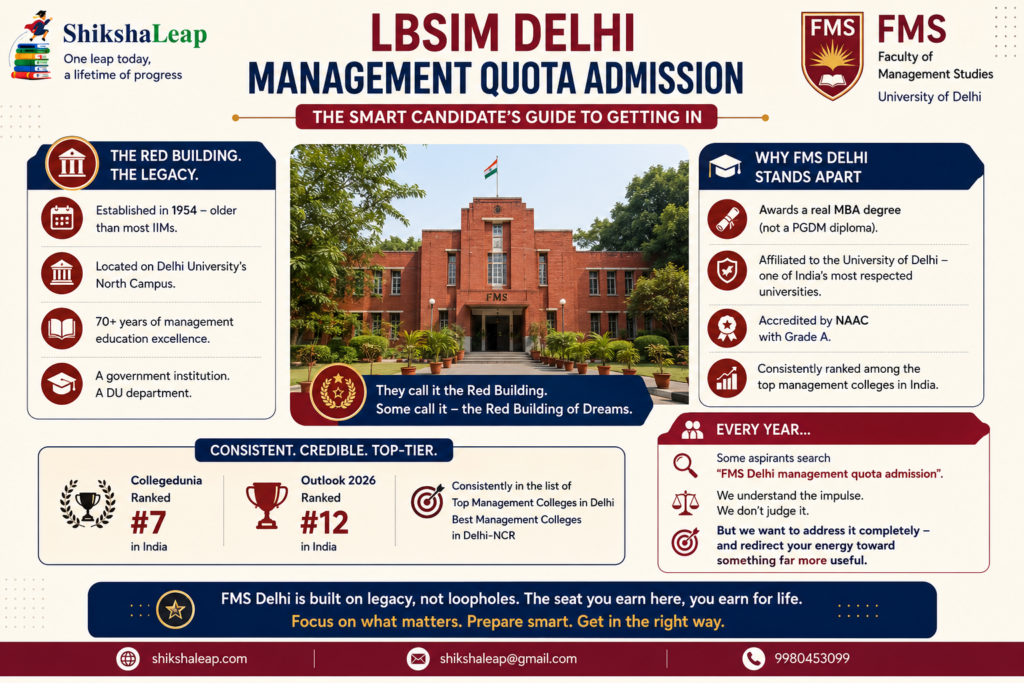
There is a building on the North Campus of Delhi University that MBA aspirants across India have given a name to without any official help. They call it the Red Building. Or, when they’re being dramatic — which is often — the Red Building of Dreams.
It’s a real building. Red brick, somewhat understated given its reputation, sitting on a leafy stretch of the University of Delhi’s North Campus, a short walk from the Metro and a short thought from the Delhi School of Economics. The Faculty of Management Studies (FMS) has occupied this space since 1954 — making it older than most of the IIMs, older than India’s liberalised economy, older than the careers of most people who now run the companies that recruit from it.
Seventy-plus years of management education. A government institution. A University of Delhi department. A programme that awards an actual MBA degree — not a PGDM diploma — because it is affiliated to one of India’s most accredited universities. Accredited by NAAC with Grade A. Consistently ranked among the top management colleges in India by every credible ranking agency: Collegedunia ranks it #7 nationally, Outlook 2026 ranks it #12, and it consistently appears in every list of the top management colleges in Delhi and the best management colleges in Delhi-NCR.
And yet, every year, some aspirants type “FMS Delhi management quota admission” into a search bar. We understand the impulse. We don’t judge it. But we do want to address it completely — and then redirect your energy toward something far more useful.
The Best MBA for Entrepreneurs in India
Let’s Settle the Quota Question for Good
FMS Delhi is administered by the University of Delhi, which is a Central University under the Ministry of Education, Government of India. Its admissions are governed by University of Delhi rules, AICTE guidelines, and the CAT process administered jointly by the IIMs.
There is no management quota. There are no donation seats. There is no private trust running FMS that can allocate seats outside the merit process.
What does exist — and what some content on the internet misleadingly calls “FMS Delhi direct admission” or “FMS Delhi PGDM management quota” — is the supernumerary seat allocation under University of Delhi norms for foreign nationals, PwD candidates, and certain other special categories. These are not management quota seats. They are constitutional and statutory provisions. The foreign national seats, for instance, require a separate application and are subject to ICCR or similar nomination processes. None of these are “pay and get in” routes.
The only people who have ever gotten into FMS Delhi’s full-time MBA without a CAT score are those who were admitted as foreign nationals through the official University process — and even that involves evaluation, not donation.
IMT Ghaziabad Admission 2027: Cutoffs, Fees, Placements & Direct Admission
Need Help with Your FMS Delhi Management Quota Admission?
Connect with ShikshaLeap today for expert guidance and personalized assistance to choose the course that best aligns with your career goals.
Call us at: +91-9980453099
Write to us at: shikshaleap@gmail.com
What FMS Delhi Is — In the Delhi B-School Ecosystem
We’ve been building a series of articles about Delhi-NCR management institutions. Let’s place FMS honestly in that map.
| Institution | Fee (Total) | Avg Placement | CAT Cutoff | Type |
| FMS Delhi | ₹2.43 L | ₹32.27 LPA | 98–99%ile | Govt (DU) |
| IIFT Delhi | ₹21.82 L | ₹31.30 LPA | 96.7–98%ile | Govt (MoC) |
| MDI Gurgaon | ₹24–26 L | ~₹25 LPA | 96–97%ile | Private |
| IMI Delhi | ₹29.78 L | ₹17.91 LPA | 90–95%ile | Private |
| FORE Delhi | ₹23.24 L | ₹16.71 LPA | 85%ile | Private |
| LBSIM Delhi | ₹17.25 L | ₹12.25 LPA | 70–85%ile | Private |
Look at FMS in that table. ₹2.43 lakhs total, ₹32.27 LPA average. The institution with the highest average placement in this list charges the lowest fee — by a factor of nine compared to IMI Delhi.
This is not a typo. This is the FMS Delhi reality. And it is why, among students who score 98–99 percentile in CAT, FMS Delhi is often chosen over IIM Indore, IIM Kozhikode, and even IIM Lucknow — despite those institutes having higher NIRF ranks and larger alumni networks. The math is genuinely hard to argue with.
Best MBA Colleges in Delhi NCR 2027: Your Gateway to Leadership and Success
One important distinction for context: FMS is not typically ranked among the “best private universities in Delhi” — because it isn’t private. It is a Central University department. But in every practical conversation about the best management colleges in Delhi, the top management colleges in India, and certainly the best management colleges in Delhi-NCR — FMS Delhi belongs at the very top of the conversation. Government funding, in this case, is not a limitation. It’s what makes the arithmetic possible.
The One Exam That Opens This Door: CAT, and Only CAT
FMS Delhi’s full-time MBA accepts exactly one entrance examination: CAT.
No XAT. No GMAT. No MAT. No CMAT. No exceptions for Indian nationals seeking the full-time programme. This singular focus on CAT is not a bureaucratic quirk — it’s a signal about the kind of institution FMS is. It doesn’t need to cast a wide net. It needs the top percentiles of CAT, and it gets them. The 2027 cycle (2026–28 batch) required:
CAT Cutoff for Shortlisting
- Overall: approximately 98 percentile (General category)
- Sectional: minimum 50 percentile in each section
- VARC carries 40% weight in the composite shortlisting score; QA carries 30%; DILR carries 30%
Relaxed Cutoffs for Reserved Categories: Delhi University reservation norms apply — SC, ST, OBC-NCL, EWS, and PwD categories have relaxed cutoffs as per government mandate. The competition within each reserved category is still significant.
What this means in practice: a 97.5 percentile CAT score is not safe for FMS. In good years, the shortlist starts from 98 and closes somewhere above 99 for General category male candidates. VARC is weighted heaviest in the shortlisting formula — a weak Verbal section will cost you even with a strong overall score.
Admission in Faculty of Management Studies (FMS) Delhi 2027
At ShikshaLeap, when a student tells us FMS is on their target list, the first conversation is always about where their mock test sectional splits are — specifically whether VARC is at the level where 40% weight on that section helps rather than hurts. This is preparation planning that most CAT coaches don’t think about early enough.
The Batch Size That Makes FMS Even More Competitive
Here is a detail that many CAT aspirants overlook: FMS Delhi’s MBA batch has 251 sanctioned seats plus 63 supernumerary seats (for PwD, foreign nationals, and other categories). For context, a typical IIM in the top six has 380–550 seats.
What this means: FMS is genuinely selective. The number of General category seats after reservation allocation is relatively small. The competition at the 98–99 percentile level is for a limited number of spots. Being above the cutoff doesn’t guarantee a call — it guarantees you’re in the eligible pool. Your composite score (CAT + academics + SOP + Extempore + PI) determines whether you convert.
This is precisely why the FMS selection process deserves as much preparation as the CAT score itself.
Is IIFT Delhi Direct Admission 2027 Possible?
The FMS Delhi Admission Selection Process
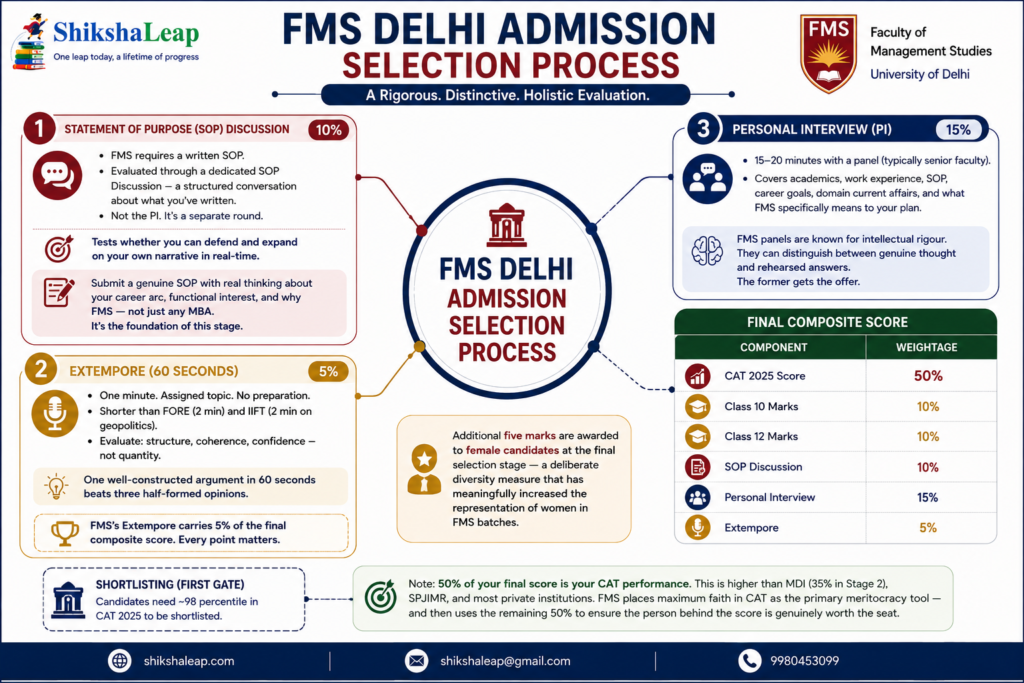
Once shortlisted — which, given the 98 percentile floor, is already a meaningful achievement — FMS calls you to its North Campus for the final evaluation. The process is distinctive in three ways:
Statement of Purpose (SOP) Discussion: It’s a separate evaluation carrying 10% of the final composite score.
Extempore (60 Seconds): One minute. Assigned topic. No preparation. You speak.
FMS’s Extempore carries 5% of the final composite score. In a process where every point matters, five percentage points at this level of competition is not trivial.
Personal Interview (PI): The conversation covers your academic background, work experience (if any), career goals, the contents of your SOP, current affairs in your domain of interest, and what FMS specifically — not just “an MBA” — means to your plan.
The PI carries 15% of the final composite score.
Is IMI Delhi Direct Admission possible in 2027?
The FMS Delhi MBA Fees – That Makes Every Financial Calculator Confused
We said ₹2.43 lakhs at the start. Let us be precise.
The total tuition fee for FMS Delhi’s 2-year full-time MBA programme is approximately ₹2 to ₹2.43 lakhs for the entire programme. Per official sources, this is the programme fee — not per semester, not per year.
Add hostel fees (Delhi University hostels are subsidised and significantly below market rates), mess charges, and personal expenses, and your total two-year cost of attending FMS Delhi — living included — is typically in the ₹5–7 lakh range. Total. For two years of a Top-10 management degree in Delhi.
Compare that to ₹29.78 lakhs at IMI Delhi, ₹26.50 lakhs at SPJIMR, ₹21.82 lakhs at IIFT. The FMS fee is not a rounding error. It’s a structural advantage built into the institution by virtue of being a Central University department.
The application fee, by the way, is ₹1,000. At a time when private B-school application fees range from ₹1,770 to ₹3,000, FMS charges ₹1,000 for a shot at ₹32 LPA average placements.
How to get Direct Admission in LBSIM Delhi 2027?
On scholarships: FMS doesn’t have a complex scholarship structure because the fee itself is the scholarship. Students from economically weaker sections benefit from the reservation framework and government-supported hostel facilities. External scholarships — OP Jindal, Aditya Birla, and others — are available to eligible FMS students and worth applying for.
The FMS Delhi Placements: What Happens at ₹2.43 Lakhs of Investment
Here is where FMS Delhi earns its legendary status — not from rankings, not from alumni nostalgia, but from the numbers.
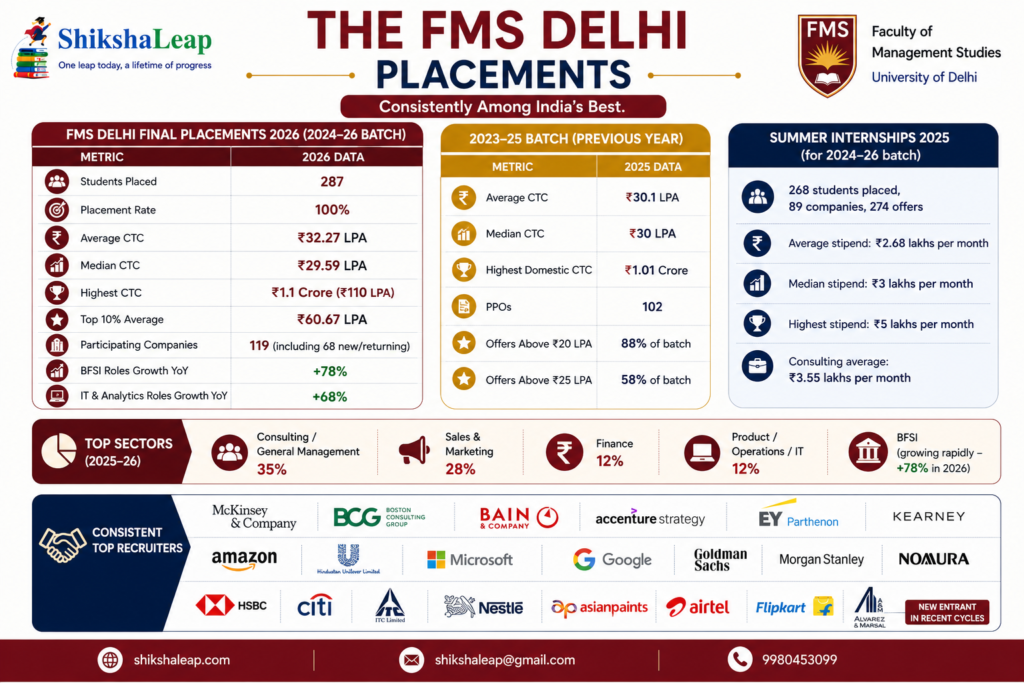
97% of the 2021–23 batch received offers above ₹20 LPA. At ₹2.43 lakhs total investment. We’ll let that sit for a moment.
How to get Direct Admission in FORE Delhi through Management Quota and NRI Quota?
FMS Delhi vs IIM Calcutta, IIM Indore, IIM Kozhikode: The Choice Many 99 Percentilers Face
This comparison comes up more often than any other for FMS aspirants — and it deserves an honest answer.
| Parameter | FMS Delhi | IIM Calcutta | IIM Indore | IIM Kozhikode |
| Degree Type | MBA (Degree) | PGDM (Diploma) | PGDM (Diploma) | PGDM (Diploma) |
| Total Fee | ₹2.43 L | ~₹27–28 L | ~₹19–21 L | ~₹19–20 L |
| Avg Package 2025–26 | ₹32.27 LPA | ~₹35–36 LPA | ~₹28–30 LPA | ~₹24–26 LPA |
| Location | Delhi (Central) | Kolkata | Indore | Kozhikode |
| CAT Cutoff | 98–99%ile | 99%ile | 97–98%ile | 97%ile |
| NIRF 2026 | Top 10-15 | #2 | #9 | #13 |
MDI Gurgaon Direct Admission 2027: Is Management Quota an Option?
Need Help with Your FMS Delhi Management Quota Admission?
Connect with ShikshaLeap today for expert guidance and personalized assistance to choose the course that best aligns with your career goals.
Call us at: +91-9980453099
Write to us at: shikshaleap@gmail.com
Why You Need Preparation — Even After Cracking 98 Percentile
Here’s the thing most FMS articles don’t say plainly: clearing the CAT cutoff is the beginning of the process, not the end.
The composite score means that 50% of your final standing is determined by what happens in the SOP Discussion, Extempore, and PI. A candidate at 99 percentile with a poorly written SOP, a rambling Extempore, and an unfocused PI has lost significant ground. A candidate at 98.2 percentile with a sharp, genuine SOP, a structured 60-second Extempore, and a PI that demonstrates clarity of purpose has a very real shot. We have seen both outcomes at ShikshaLeap. Too many times. Here’s what we do for FMS Delhi aspirants specifically:
- CAT Strategy with VARC Priority
- SOP Development and Discussion Coaching
- 60-Second Extempore Training
- FMS-Specific PI Preparation
- Academics Optimisation
📞 Call ShikshaLeap at 9980453099 ✉️ Write to us at shikshaleap@gmail.com If you are targeting FMS Delhi — whether you’re already at 98 percentile or working toward it — let’s have a conversation about where you actually stand and what preparation will change your outcome. Not a sales pitch. A twenty-minute strategy call. ShikshaLeap — One Leap Today. A Lifetime of Progress.
The Closing Calculation for FMS Delhi
We started this article with arithmetic. Let’s end with it.
₹2.43 lakhs in tuition. ₹32.27 LPA average salary out. A highest package of ₹1.1 crore. A median of ₹29.59 LPA. 100% placement rate. McKinsey, BCG, HUL, Goldman Sachs, Google, Amazon — all recruiting from a government institution on the North Campus of Delhi University that charges less per year in fees than most South Delhi restaurants charge per month in rent.
There is no management quota here. There is no shortcut. There is no amount of money you can pay that will substitute for a 98 percentile CAT score, a thoughtful SOP, 60 seconds of structured confidence, and a personal interview that proves you belong in the Red Building.
The door to FMS Delhi is the hardest of any institution in this series to open. And the room on the other side of it — with ₹32 LPA on the table, ₹2.43 lakhs on the invoice, and the Delhi University MBA stamp on your degree — is the most extraordinary ROI in Indian management education.
Stop searching for shortcuts into it. Start preparing for the door that’s actually there.
➡️ Start your FMS Delhi journey with confidence — Let ShikshaLeap guide you every step of the way!
ShikshaLeap wishes each and every Aspirant, best of Luck for your Journey! You already won the day to decide to go for it so let not anything stop you from achieving your goal and if you have any doubt regarding anything maybe it is the entrance exam, interview prep or profile building we are there as your Friend, Philosopher & Guide!
Let’s TALK @ 9980453099
FAQs About FMS Delhi MBA Direct Admission
Q1. Does FMS Delhi have a management quota?
No. FMS Delhi is a government institution under the University of Delhi (a Central University). Admissions are entirely CAT-driven. There is no management quota, donation seat, or any payment-based entry mechanism. Some aggregator websites have published incorrect information on this — always verify at fms.edu.
Q2. Does FMS accept GMAT, XAT, or any exam other than CAT?
No. The full-time MBA at FMS Delhi accepts CAT scores only. No other entrance exam is accepted for Indian national applicants to the full-time programme.
Q3. What is the actual total fee at FMS Delhi?
Approximately ₹2 to ₹2.43 lakhs for the entire two-year programme. Application fee: ₹1,000. Hostel and mess are separate and subsidised by the University. Total two-year cost including living is typically ₹5–7 lakhs.
Q4. What CAT percentile is needed for FMS Delhi?
98 percentile overall for General category candidates, with a minimum of 50 percentile in each section. VARC has the highest shortlisting weight (40%). The cutoff has been at 98 for several consecutive years.
Q5. Does FMS Delhi award an MBA degree or a PGDM diploma?
FMS Delhi awards an actual MBA degree — because it is affiliated with the University of Delhi. This is different from IIM PGDMs and most private B-school PGDMs, which are diplomas.
Q6. Can NRI or foreign candidates apply to FMS Delhi?
Foreign nationals can apply through supernumerary seats under the University of Delhi’s international student programme. This is a separate, formal process — not a management quota. Contact the University of Delhi’s International Students Centre for details.
Q7. What is the FMS SOP Discussion round?
FMS requires a written Statement of Purpose and evaluates it through a dedicated discussion round (separate from the PI). It carries 10% of the final composite score. Candidates must be prepared to discuss, defend, and expand on every element of their SOP in real time.
Also read about:
- XLRI Delhi Management Quota Admission 2027: Let’s Have the Honest Conversation Nobody Else Will
- IMI Delhi Management Quota Admission 2027: What’s Real, What’s a Myth, and What Actually Gets You In
- FORE Delhi Management Quota Admission: The Straight Answer, the Smart Strategy, and Everything in Between
- IIFT Delhi Management Quota Admission: Why the Shortcut Question Misses the Point Entirely
- LBSIM Delhi Management Quota Admission: The Smart Candidate’s Guide to Getting In
If you’re planning to pursue Engineering and want to explore top Engineering colleges, courses, and admission options, Visit: Direct Admission to Top Private Engineering Colleges in India | Shiksha Tech
OR
If you’re planning to pursue MBBS and want to explore Top MBBS Colleges, courses, and admission options, Visit: Direct Admission to Top Medical Colleges in India | Dr. Shiksha