

The Financial Times Global ISB Hyderabad Management Quota Admission MBA Ranking 2026 places ISB Hyderabad at #27 in the world and #5 in Asia — making it the highest-ranked business school in India by any major international ranking body.
Every year, without fail, thousands of searches include “ISB Hyderabad management quota admission,” “ISB Hyderabad PGP Admission,” and “ISB Hyderabad direct admission.”
Sit with that contradiction for a moment.
A school ranked higher than INSEAD Singapore, higher than China Europe International Business School, and higher than every Canadian and Australian business school in the FT Global MBA list — is being asked whether it has donation seats.
We’re not saying this to mock the people who search those terms. We’re saying it because the gap between how ISB presents itself globally and how some applicants perceive their chances locally is genuinely interesting. And understanding why that gap exists — and what actually fills it — is the most useful thing this article can do for you.
The short answer: There is no management quota at ISB Hyderabad. No donation seats. No direct admission that bypasses the evaluation process. ISB is a private, not-for-profit institution whose founding partners include the Wharton School, the Kellogg School of Management, and the London Business School. The accreditation it holds — AACSB, EQUIS, and AMBA simultaneously — makes ISB one of fewer than 110 business schools in the world with all three. Not one of those 110 schools has a functioning management quota system.
The longer, more useful answer occupies the rest of this article. And there’s an update buried in it that affects every ISB applicant — something most guides haven’t caught yet.
Also read about: Top MBA Colleges in India
We’re ShikshaLeap. We help serious MBA aspirants navigate complex, multi-stage admissions processes like ISB’s. Call us at 9980453099 or write to shikshaleap@gmail.com. If ISB is on your radar, this is the conversation to have before you start your application.
The Update Most Guides Are Missing
Before anything else — this matters.
ISB’s official admissions page now carries this notice, and it changes the planning timeline for a significant number of applicants:
“Please note that our previous Young Leaders’ Programme (YLP) and Early Entry Option (EEO), which served as deferred entry routes to PGP, have been discontinued.”
For years, the YLP and EEO were ISB’s most popular pathways for final-year students and fresh graduates — allowing talented young candidates to secure a deferred ISB PGP seat before starting their careers. Thousands of aspirants planned their post-graduation trajectory around these routes.
Both are now discontinued.
What has replaced them is the PGP YL — the Post Graduate Programme in Management for Young Leaders — a 20-month, fully residential programme designed for candidates with up to 24 months of work experience, running at both the Hyderabad and Mohali campuses. PGP YL is not a deferral mechanism. It is a direct, active programme — you apply, get in, and start. Fresh graduates are explicitly welcome.
This is not a downgrade. The PGP YL accepts GMAT, GRE, or CAT scores (CAT 98–99%ile+ recommended), follows a holistic evaluation process, and is designed to accelerate the management career of early-talent candidates through ISB’s world-class curriculum.
Also read about: The Best MBA for Entrepreneurs in India
If you were planning to apply for YLP and haven’t seen this update — you have now. Plan accordingly.
Need Help with Your ISB Hyderabad Management Quota Admission?
Connect with ShikshaLeap today for expert guidance and personalized assistance to choose the course that best aligns with your career goals.
Call us at: +91-9980453099
Write to us at: shikshaleap@gmail.com
What ISB Hyderabad Actually Is — For Anyone Who Needs the Context
The Indian School of Business was established in 2001 — not by a government ministry, not by an industrial conglomerate, but through a partnership between three of the world’s leading business schools: the Wharton School (University of Pennsylvania), the Kellogg School of Management (Northwestern University), and the London Business School. These institutions didn’t just lend their name. They contributed faculty, curriculum design, and academic governance.
Twenty-four years later, ISB is India’s only business school with Triple Crown Accreditation — AACSB, EQUIS, and AMBA simultaneously. To put that in perspective: of the roughly 16,000 business schools globally, fewer than 110 have earned all three. Among Top Indian B-schools, ISB is the only one. IIM Ahmedabad has AMBA. XLRI has AACSB and AMBA. Only ISB has all three.
The main campus sits in Gachibowli, Hyderabad — a few kilometres from HITEC City, India’s largest IT and technology services cluster. Across the road, in a very practical sense, are the Indian offices of Google, Microsoft, Deloitte, HSBC, Accenture, and Goldman Sachs. The proximity is not incidental.
The Mohali campus — ISB’s second campus in Punjab — was established to extend the ISB experience to North India, with the same curriculum and faculty standards.
Alumni: Over 16,000 ISB alumni across 60+ countries. 800+ alumni currently serving as CXOs. This is the network you’re buying into — active, global, and genuinely useful in a way that matters when you’re negotiating a senior role fifteen years from now.
Also read about: Best MBA Colleges in Delhi NCR 2027: Your Gateway to Leadership and Success
When people talk about the best management college in India or the best management college in Hyderabad — ISB’s global ranking makes the answer fairly direct. It is not a regional conversation. It is a world-ranking conversation, and ISB competes at that level.
ISB Hyderabad PGP Programmes Portfolio: ISB Isn’t One Programme. It’s Five Different MBA Tracks
This is where most articles about ISB oversimplify — and where the “management quota” question sometimes comes from genuine confusion about which programme applies to whom.
ISB offers five distinct management programmes, each designed for a specific career stage and life situation:
PGP — Post Graduate Programme in Management (Flagship) 12 months. Fully residential. Both Hyderabad and Mohali campuses. For professionals with a minimum of 2 years of full-time work experience. Requires GMAT or GRE. Intake: approximately 900 students. This is the programme that carries the FT #27 ranking. Application fee: ₹5,000.
PGP YL — Post Graduate Programme for Young Leaders 20 months. Fully residential. For candidates with 0–24 months of work experience. Fresh graduates are eligible. Requires GMAT, GRE, or CAT score. Acceptance rate: approximately 5–7%. Two application rounds per cycle; Round 1 typically closes in December. This replaced the discontinued YLP and EEO routes.
PGPpro — Post Graduate Programme for Professionals 18 months, blended learning format (weekend-intensive modules). Designed for professionals with 5+ years of work experience who cannot take a career break. GMAT not mandatory — admission is profile-based followed by interview. Locations: Hyderabad, Mumbai, Bangalore, Delhi. Approximate fee: ₹35.51 lakhs.
PGPMAX — Post Graduate Programme for Senior Executives 15 months, modular residential structure. For professionals with 10–25 years of work experience. Admission is interview and profile-based; GMAT optional. Fee: approximately ₹41.78–49.50 lakhs. Note: PGPMAX is the only Executive MBA from India ranked in the FT Global EMBA Top 50 — a genuinely rare distinction.
PGP MFAB — Post Graduate Programme for Family Business 15 months. Specifically designed for next-generation family business leaders who want to build the management capability to run, modernise, or scale the family enterprise. Admission via Business Aptitude Test (BAT) + Personal Interview. Includes a Global Immersion module at Kellogg School of Management (USA). Fee: approximately ₹42.13 lakhs.
Each programme has different entry requirements, different fee structures, and different career outcomes. If someone told you “ISB has a management quota for the PGPMAX” — even that specific claim would be false. PGPMAX uses profile shortlisting and interview. There is no payment lane into any of ISB’s five programmes.
Also read about: ISB Hyderabad Direct Admission 2027: Indian School of Business – The Architecture of Excellence
Need Help with Your ISB Hyderabad Management Quota Admission?
Connect with ShikshaLeap today for expert guidance and personalized assistance to choose the course that best aligns with your career goals.
Call us at: +91-9980453099
Write to us at: shikshaleap@gmail.com
How ISB Hyderabad Actually Evaluates You: The Holistic Process Explained
The ISB PGP admission evaluation is one of the most sophisticated holistic processes among Indian B-schools. Here’s how it works:
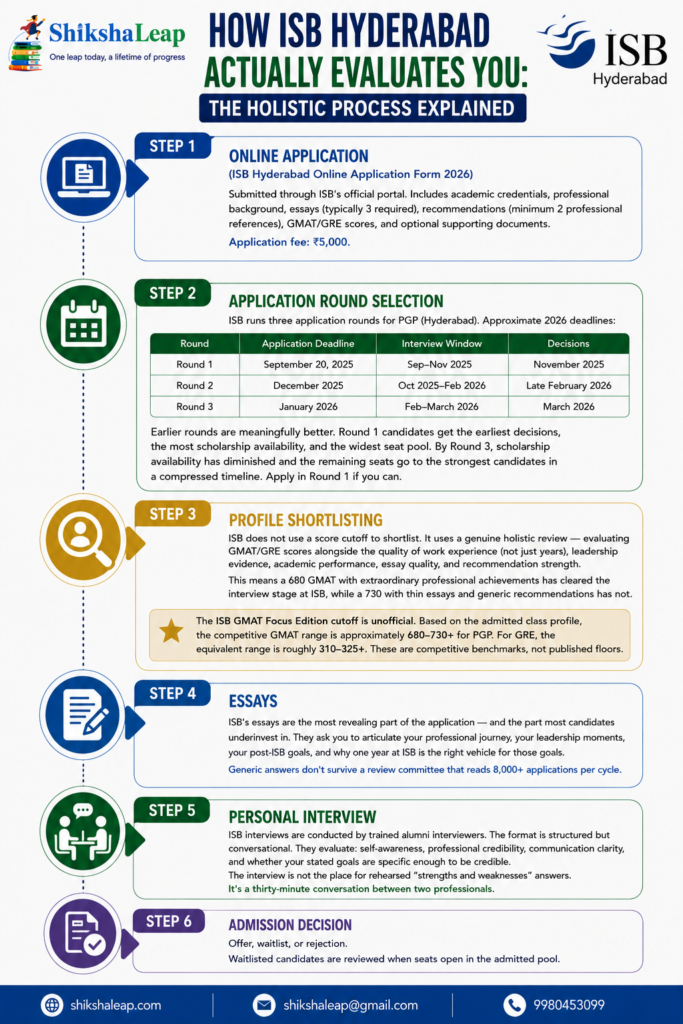
Can you get into ISB without GMAT or GRE? For PGP: no, GMAT or GRE is mandatory. For PGP YL: GMAT, GRE, or CAT are accepted. For PGPpro, PGPMAX, and PGP MFAB: formal test scores are either not required or optional, with profile and interview carrying the selection weight.
Also read about: ISB Hyderabad Direct Admission 2027 – Eligibility | Fees | Placements | Ranking |Management/NRI Quota Guide
The ISB Hyderabad NRI Quota and Corporate Sponsor Questions
Two specific searches around ISB quota deserve direct answers:
ISB Hyderabad NRI quota admission fees: ISB does not have a separate NRI quota. International applicants and NRI candidates go through the same PGP application process as Indian applicants. ISB has a deliberate international diversity goal — approximately 15–20% international representation in each PGP batch — but this is achieved through the standard holistic admission process, not through a separate fee-based track.
ISB Hyderabad corporate sponsor quota seats: ISB does not have corporate quota seats in the traditional sense. What exists is a company sponsorship track — where an employer officially sponsors an employee’s PGP participation, covering fees and potentially continuing their employment relationship. This is a formal, disclosed arrangement. It does not bypass the application and interview process. The candidate must still apply, be shortlisted, and clear the interview. The sponsorship merely changes who pays the fee.
Also read about: Admission in ISB Hyderabad & Mohali: The Ultimate 2027 Guide to One of India’s Best MBAs
ISB Hyderabad Fees, Scholarships, and the Education Loan Path
ISB Hyderabad Programme Fees:
| Programme | Approximate Total Fee |
| PGP YL (20 months) | ~₹30,20,800 |
| PGPpro (18 months) | ~₹39,76,080 |
| PGPMAX (15 months) | ~₹50,78,140 |
| PGP MFAB (15 months) | ~₹52,78,000 |
ISB Hyderabad Scholarships: ISB offers one of the most comprehensive scholarship portfolios among Indian business schools:
- Merit Waivers: 25% to 100% tuition fee waiver based on academic and professional excellence
- Dean Don Jacobs Award: for exceptional leadership demonstrated outside professional settings
- Develop India Scholarship: for candidates committed to India-development careers
- ISB Merit by Diversity: specific support for women, first-generation professionals, and SC/ST candidates
- ISB Scholarship for Women Leaders: targeted support for women in business
- AIESEC–ISB Waivers: for AIESEC alumni with demonstrated social leadership
- International Diversity Scholarship: for candidates who add geographic diversity to the batch
- Bridge to India: for Indian diaspora returning to India
- Need-Based Waivers: for candidates with demonstrated financial need
Educational Loans for ISB Hyderabad: ISB is covered under the SBI Scholar Loan Scheme — the same scheme covering IIM A, B, C, and XLRI Jamshedpur — offering up to ₹40 lakhs without collateral. HDFC Credila, Avanse, and Incred also have ISB-specific loan products with competitive rates. Given ISB’s placement outcomes, loan approval rates for admitted candidates are high.
Also read about: SP Jain Mumbai Direct Admission 2027: Exploring Management & NRI Quota Paths
The ROI of ISB’s one-year MBA, when calculated honestly: ₹38–45 lakhs invested, average placement of ₹32–35 LPA after one year, international placement opportunities at ₹60+ LPA for the top quartile. Payback period at average salary: approximately 15–18 months post-graduation for most students. For a one-year programme, that’s a compelling financial argument.
Need Help with Your ISB Hyderabad Management Quota Admission?
Connect with ShikshaLeap today for expert guidance and personalized assistance to choose the course that best aligns with your career goals.
Call us at: +91-9980453099
Write to us at: shikshaleap@gmail.com
ISB Hyderabad Placement Story: What Happens After Gachibowli
ISB’s placement data is strong by any benchmark — not just among Indian schools.
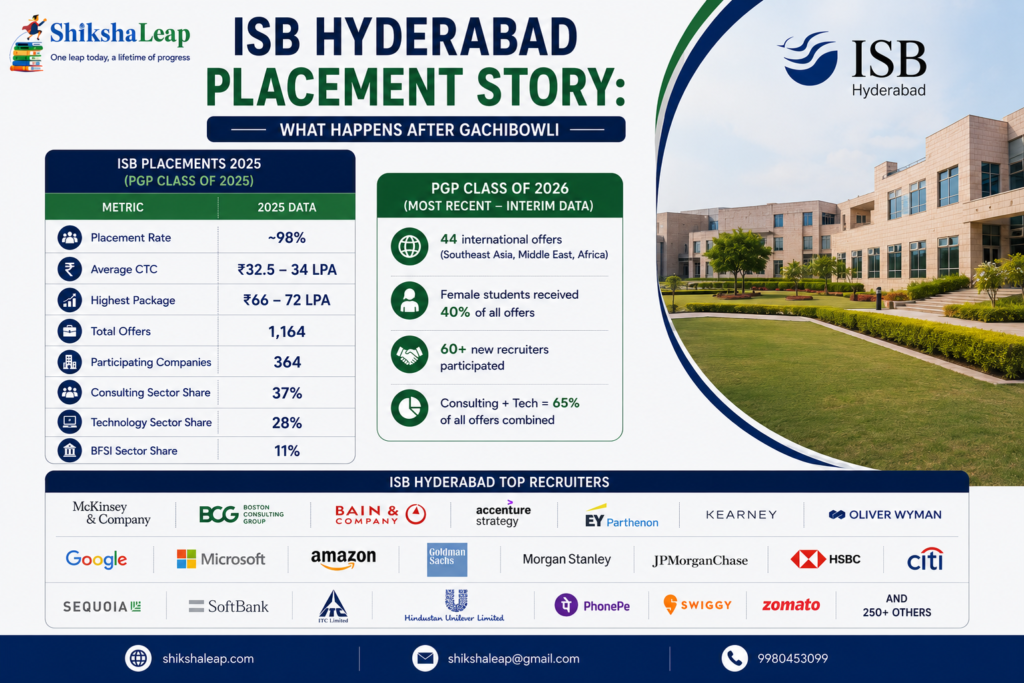
ISB’s integrated 10-day placement window deserves specific mention because it is genuinely different from how IIMs and most other schools run placements. Instead of a multi-week, rolling process, ISB compresses its placement drive into a focused 10-day period — creating intensity, urgency, and transparency for recruiters that a drawn-out process doesn’t achieve. Companies know they are competing against each other in real time. This compression, paradoxically, often produces better outcomes for students.
Also read about: Is BITSOM Mumbai Direct Admission 2027 Possible? – Admission | Placements | Fees | Ranking | Quota Guide
ISB consulting and tech product management placements are specifically worth noting: in the 2026 batch, Consulting alone accounted for 37% of offers, with firms like McKinsey, BCG, and Bain recruiting in double digits. For candidates targeting strategy consulting, ISB’s placement outcomes in this sector rival IIM Calcutta and occasionally IIM Ahmedabad.
ISB Hyderabad vs IIM Ahmedabad: The Honest Comparison
This comparison comes up in virtually every ISB application conversation, and deserves a direct, data-based answer rather than diplomatic equivocation.
| Parameter | ISB Hyderabad | IIM Ahmedabad |
| FT Global MBA Ranking 2026 | #27 worldwide, #5 Asia | Not ranked (FT excludes PGPs) |
| Programme Length | 12 months (PGP) | 2 years (PGP) |
| Accreditation | AACSB + EQUIS + AMBA | AMBA only |
| Total Fee | ~₹38–45 Lakhs | ~₹27–28 Lakhs |
| Average Package 2026 | ₹32.5–34 LPA | ~₹35–38 LPA |
| Consulting Outcomes | Very Strong (37% of batch) | Outstanding |
| International Offers | 44 | Limited |
| Entry Requirement | GMAT/GRE + 2 yrs work-ex | CAT 99.9%ile |
| Duration Advantage | ✅ 1 year (faster ROI) | ❌ 2 years |
| Domestic Brand Recognition | Very Strong | Exceptional |
The answer is not “one is better.” The answer is “which one is built for your specific next chapter?”
Also read about: IIM Ranchi Direct Admission 2027 in Integrated BBA + MBA (IPM) with Management & NRI Quota
How ShikshaLeap Helps With ISB Hyderabad PGP Admission?
ISB’s admission process has specific bottlenecks where preparation changes outcomes. Here’s where we focus:
- GMAT Strategy for ISB-Level Scores
- ISB Application Essay Review Services
- Profile Positioning for Holistic Review
- ISB Interview Preparation Timeline
- PGP YL Application Strategy
- Programme Selection: PGP vs PGPpro vs PGPMAX
📞 Call ShikshaLeap at 9980453099 ✉️ Write to us at shikshaleap@gmail.com ISB applications are complex, multi-component, and essay-intensive. The difference between an application that clears review and one that doesn’t is rarely the GMAT score. It’s the essays and the interview. Let’s start building yours properly. ShikshaLeap — One Leap Today. A Lifetime of Progress.
➡️ Start your ISB Hyderabad journey with confidence — Let ShikshaLeap guide you every step of the way!
ShikshaLeap wishes each and every Aspirant, best of Luck for your Journey! You already won the day to decide to go for it so let not anything stop you from achieving your goal and if you have any doubt regarding anything maybe it is the entrance exam, interview prep or profile building we are there as your Friend, Philosopher & Guide!
Let’s TALK @ 9980453099
FAQs Abouit ISB Hyderabad PGP Management Quota Admission
Q1. Is there a management quota at ISB Hyderabad?
No. ISB Hyderabad does not offer management quota seats, donation seats, or any payment-based admission pathway. Admission is holistic — evaluating GMAT/GRE, work experience, essays, recommendations, and interview performance. There are no shortcuts.
Q2. Is the YLP (Young Leaders Programme) still available?
No. ISB has officially discontinued both the YLP and the Early Entry Option (EEO). They have been replaced by the PGP YL — a 20-month direct programme for candidates with 0–24 months of work experience. Fresh graduates are eligible to apply directly.
Q3. Can I get into ISB without GMAT or GRE?
For PGP (flagship): No. GMAT or GRE is mandatory. For PGP YL: GMAT, GRE, or CAT are accepted. For PGPpro, PGPMAX, and PGP MFAB: formal test scores are not required — admission is profile and interview-based.
Q4. What is the ISB GMAT cutoff for PGP admission?
ISB does not publish an official cutoff. Based on the admitted class profile, competitive candidates typically have GMAT scores of 680–730+. However, scores below 700 with exceptional profiles have been admitted, and scores above 730 with weak essays and thin work experience have been declined.
Q5. What is the total cost of ISB PGP including hostel?
Approximately ₹38.67 lakhs for shared accommodation (inclusive of all fees and GST). Studio accommodation: approximately ₹41.65 lakhs. Additional living expenses (food, travel, personal): estimated ₹6.45 lakhs for the year. Total all-in: approximately ₹45–48 lakhs.
Q6. What is the ISB NRI quota admission process?
ISB does not have a separate NRI quota. NRI and international applicants go through the same holistic PGP admission process. ISB actively seeks international diversity in its batch — but through merit evaluation, not through a separate fee-based track.
Q7. How does ISB’s 10-day integrated placement window work?
Unlike IIMs and most B-schools that run multi-week rolling placement drives, ISB compresses its primary placement activity into a 10-day intensive window. Companies compete simultaneously, creating urgency and transparency. This typically produces faster offer conversions and allows ISB to coordinate a higher volume of recruiters in a structured timeframe.
Also Read About:
- FMS Delhi Management Quota Admission: The Arithmetic That Changes Everything
- BIMTECH Noida Management Quota Admission: BIMTECH PGDM Admission
- MDI Gurgaon Management Quota Admission: Three Questions, Three Honest Answers, One Definitive Guide
- Masters’ Union Gurgaon Management Quota Admission: The School That Doesn’t Fit the Template
- XLRI PGDM Management Quota Admission — Everything You Actually Need to Know Before You Apply
If you’re planning to pursue Engineering and want to explore top Engineering colleges, courses, and admission options, Visit: Direct Admission to Top Private Engineering Colleges in India | Shiksha Tech
OR
If you’re planning to pursue MBBS and want to explore Top MBBS Colleges, courses, and admission options, Visit: Direct Admission to Top Medical Colleges in India | Dr. Shiksha
External References:
ISB PGP Application Deadlines — Official Page ISB Hyderabad Official Placement Reports Financial Times Global MBA Rankings 2025 ISB Hyderabad — Official Website GMAT Official Website — mba.com CAT 2026 Official Website