

JBIMS Mumbai does not interview you for MMS admission.
No Group Discussion. No Written Ability Test. No Personal Interview. No psychometric test, no video essay, no SOP, no recommendation letters. The Jamnalal Bajaj Institute of Management Studies — one of India’s most respected and longest-standing business schools, a government institution under the University of Maharashtra that has been producing CEOs since 1965 — evaluates you entirely on one number from one exam.
Your MAH MBA CET percentile.
That’s it. That is the whole MMS admission process for JBIMS Mumbai Management Quota Admission. Score 99.94–99.99 percentile in MAH MBA CET. Register through the DTE Maharashtra CAP portal. List JBIMS Mumbai as preference 1 in your option form. Hope the percentile holds. Receive the seat allotment letter or watch it go to someone whose percentile was 0.01 higher than yours.
The absence of interviews does not make JBIMS easier to get into. It makes JBIMS the institution where your CET percentile — not your interview coaching, not your application essay, not your work experience narrative — is the only variable. Nothing can substitute for it. Nothing can compensate for a score that doesn’t clear 99.94. And nothing can prevent you from getting a seat if you do.
This is why JBIMS manages to be simultaneously the most exam-pure and the most financially extraordinary management education in Mumbai. The admission requires one thing done at one very high level. And the outcome — ₹26+ LPA average, ₹87 LPA highest, placement partners that include McKinsey, Goldman Sachs, JP Morgan, and BCG — is delivered from a campus in Churchgate, South Mumbai, with a total two-year fee of ₹6.20 lakhs.
Before we go further: management quota admission in JBIMS Mumbai does not exist. JBIMS is a government institution under the University of Mumbai, and its MMS admissions are conducted through DTE Maharashtra’s Centralised Admission Process (CAP). The Maharashtra government manages the process.
Now let’s talk about what actually works.
We’re ShikshaLeap. We’ve helped MAH CET aspirants build targeted preparation strategies for JBIMS-level scores. Call us at 9980453099 or write to shikshaleap@gmail.com.
The Institution That Built India’s First MMS Programme — in 1965
Here is a fact that reframes every conversation about JBIMS: when Jamnalal Bajaj Institute of Management Studies established its Master of Management Studies programme in 1965, IIM Ahmedabad’s PGP programme was four years old. IIM Calcutta had just opened. Most of the institutions in this article series had not been conceived.
JBIMS’s MMS was the first MMS programme in India. It predates the PGDM model, the private B-school wave, and the CAT-driven IIM admissions ecosystem. Sixty years later, it still runs under the University of Mumbai, still occupies the same red-brick building in Churchgate, still charges government-regulated fees, and still produces graduates that McKinsey, Goldman Sachs, and JP Morgan hire.
JBIMS Mumbai — Official WebsiteThe campus is in Churchgate, South Mumbai — not an educational zone, not an IT park, not a knowledge city. Churchgate is India’s financial capital in its most literal form. Walk out of the JBIMS gate and you are within ten minutes of the Bombay Stock Exchange, the National Stock Exchange’s south Mumbai offices, the Reserve Bank of India, and the headquarters of HDFC Bank, Axis Bank, Kotak Mahindra, and a dozen other BFSI institutions that dominate JBIMS’s placement reports.
This is not incidental. When you graduate from JBIMS, your placements happen in the buildings your campus overlooks. The industry access during the programme — for internships, for speaker sessions, for project work — is structural, not engineered. It is a product of the address.
“CEO Factory” is the nickname that has followed JBIMS for decades. The institution claims more than 50 CEOs of Fortune 500 companies among its alumni. Names across BFSI, consulting, and Indian conglomerates. The alumni network that a JBIMS MMS degree gives you access to is one of the oldest and most professionally active management alumni communities in India.
The Best MBA for Entrepreneurs in India
Among best government MBA colleges in India, JBIMS’s combination of NIRF ranking, placement outcomes, fee structure, and Churchgate location is unmatched. Among best management colleges in Mumbai, it sits below ISB in global accreditation but above most private institutions in ROI. Among top management colleges in Maharashtra, it is the institution every MAH CET aspirant targets first.
Need Help with Your JBIMS Mumbai Management Quota Admission?
Connect with ShikshaLeap today for expert guidance and personalized assistance to choose the course that best aligns with your career goals.
Call us at: +91-9980453099
Write to us at: shikshaleap@gmail.com
The ₹6.20 Lakh Fee and ₹26.48 LPA Average: The ROI That Requires No Analysis
We have written in this series about FMS Delhi (₹2.43 lakhs in, ₹32.27 LPA average out). JBIMS’s numbers occupy a similar extraordinary position:
Total MMS fee for two years: ₹6.20 lakhs.
Average placement 2025: ₹26.12–26.48 LPA.
Highest package 2025: ₹55.60–87.12 LPA (sources report different figures; the conservative figure across multiple verified sources is ₹55.60 LPA, with some sources reporting ₹87.12 LPA from one offer).
At ₹6.20 lakhs investment, a JBIMS graduate earning the average package of ₹26 LPA covers the entire MBA fee within three months of their first salary.
That is not a ROI calculation that requires a spreadsheet. It requires a single brain cell, and it consistently makes JBIMS one of the most financially rational management education decisions available to an MBA aspirant in India.
Direct Admission in JBIMS Mumbai 2026 – Cutoff | Fees | Placements | Ranking | Quota Seats
The reason this fee is so low is the same reason management quota doesn’t exist: JBIMS is a government institution. Its fees are regulated by Maharashtra’s government framework, not by a trust or private board. The government fee regulation that prevents JBIMS from charging what a private B-school might is the same framework that prevents it from allocating seats outside the CET/CAP merit process. The low fee and the absence of management quota are two sides of the same institutional coin.
When people look for the Jamnalal Bajaj ROI comparison with IIMs: JBIMS’s average package (₹26.48 LPA) competes with IIM Indore and IIM Kozhikode. Its fee (₹6.20 lakhs) is roughly one-third of theirs. The fee-to-average-package ratio at JBIMS is more favourable than at almost any IIM outside the original three.
Best MBA Colleges in Delhi NCR 2026
The Five Programmes at JBIMS Mumbai: MMS Is Not the Only Conversation
Most JBIMS guides discuss only the MMS programme. JBIMS offers five distinct programmes, each with a different admission pathway.
| Programme | Duration | Admission Basis | Selection Process |
| MMS (Flagship) | 2 Years | MAH MBA CET / CAT / CMAT | DTE CAP Rounds (Merit-based) |
| MSc Finance | 2 Years | MAH MBA CET / CAT | WAT + Group Activity + PI |
| MHRD | 2 Years | MAH MBA CET / CAT | WAT + Group Activity + PI |
| Part-Time MMS | 3 Years | Institute Entrance Test | CET + Group Discussion |
| PhD | Variable | PET / NET / SET / JRF | Research Proposal + Interview |
JBIMS Mumbai MAH CET Cutoff: What 99.99 Percentile Actually Means
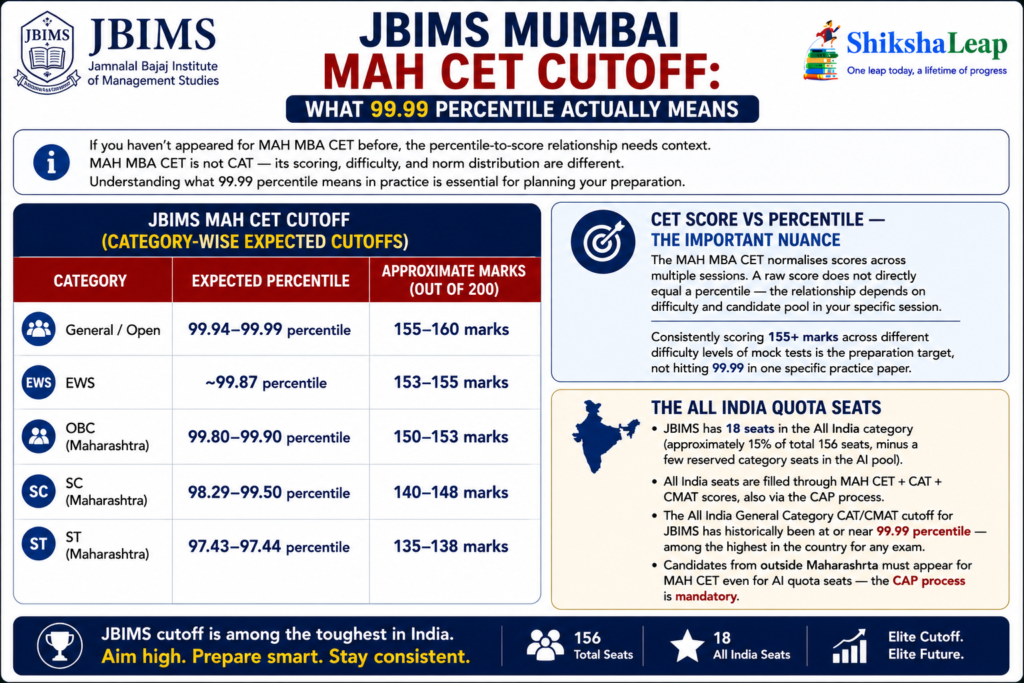
How to get 99.99 percentile for JBIMS: This question has one answer. Consistent, structured MAH MBA CET preparation targeting 155+ marks across all three sections (Verbal Ability, Logical Reasoning, and Abstract Reasoning) over a minimum of four to six months of dedicated preparation, with weekly full-length mock tests and systematic error analysis. There is no other path.
JBIMS Mumbai Scholarships and the Financial Support Structure
At ₹6.20 lakhs total fee, JBIMS already removes most of the financial barrier that blocks access to comparable private B-school education. The scholarship layer reduces it further for eligible candidates.
| Category | Scholarship/Scheme Name | Key Eligibility | Application Process |
| Government | MahaDBT Portal | SC, ST, VJ/NT, OBC, SBC, EWS | Online via MahaDBT Portal |
| Category-Specific | SC/ST Fee Waiver | Reserved Category Students | Via DTE/College process at admission |
| Institutional | Smt. Jyoti Dwivedi Memorial | Academic merit / Financial need | Direct contact with JBIMS Admin |
| Merit/Need | Merit-cum-Need | High performers with financial need | Via Institute Scholarship Committee |
For a ₹6.20 lakh programme where the average placement is ₹26.48 LPA, even the MahaDBT scholarship covering one semester of fees changes the net investment meaningfully. Every eligible candidate should apply.
NMIMS Mumbai Direct Admission 2026 through Management and NRI Quota
Need Help with Your JBIMS Mumbai Management Quota Admission?
Connect with ShikshaLeap today for expert guidance and personalized assistance to choose the course that best aligns with your career goals.
Call us at: +91-9980453099
Write to us at: shikshaleap@gmail.com
The JBIMS Mumbai Placement Story: Why They Call It the CEO Factory
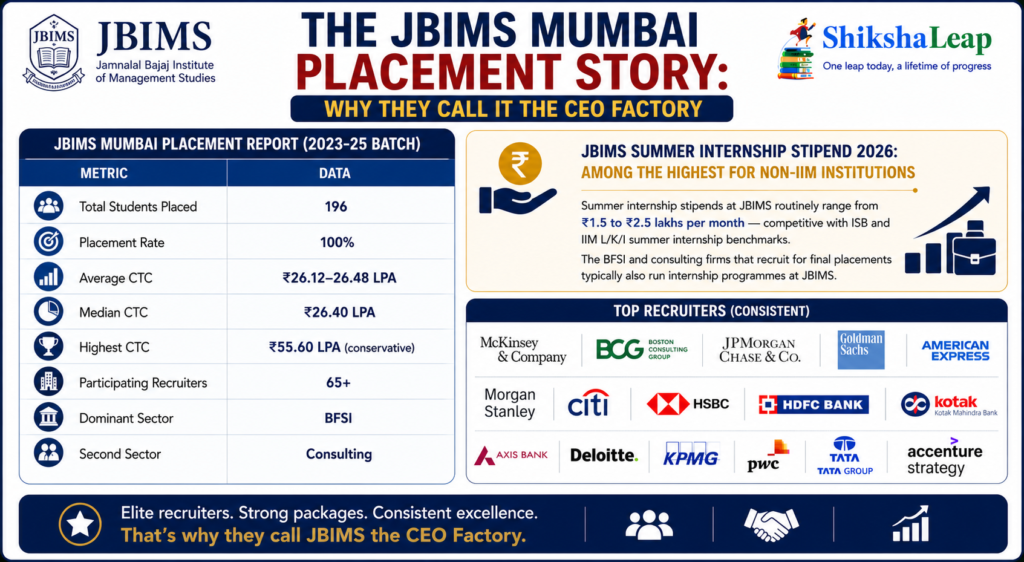
JBIMS BFSI sector placement percentage: Typically 40–50% of the batch lands in BFSI — making JBIMS the most BFSI-concentrated placement profile among non-IIM institutions. The geographic reason is obvious. The programmatic reason is that JBIMS’s finance-heavy curriculum, Churchgate location, and sixty years of alumni in Mumbai’s banking sector create a pipeline that structures itself.
The “CEO Factory” claim is not just alumni nostalgia. It reflects sixty years of JBIMS graduates moving through Mumbai’s BFSI and consulting ecosystem into leadership roles. The alumni network is specifically deep in banking (both Indian and international), financial services, and consulting — which is also where the highest placement packages consistently originate.
SP Jain Mumbai Direct Admission 2026: Exploring Management & NRI Quota Paths
How ShikshaLeap Helps JBIMS Mumbai MBA Aspirants?
Since JBIMS MMS admission is entirely CET percentile based — no GD, no PI, no alternative pathway — ShikshaLeap’s value for JBIMS aspirants is concentrated at the exam preparation and CAP strategy stages.
- ShikshaLeap MAH CET Preparation Strategy
- Targeting 155+ marks for JBIMS
- ShikshaLeap JBIMS CAP Counselling Advice
- MSc Finance WAT + PI Preparation
- All India Quota Strategy
- Parallel College List with JBIMS as Anchor
📞 Call ShikshaLeap at 9980453099 ✉️ Write to us at shikshaleap@gmail.com JBIMS is the most exam-pure top B-school in India. Everything rides on one number. Let’s make sure your number is the right one. ShikshaLeap — One Leap Today. A Lifetime of Progress.
➡️ Start your JBIMS Mumbai journey with confidence — Let ShikshaLeap guide you every step of the way!
ShikshaLeap wishes each and every Aspirant, best of Luck for your Journey! You already won the day to decide to go for it so let not anything stop you from achieving your goal and if you have any doubt regarding anything maybe it is the entrance exam, interview prep or profile building we are there as your Friend, Philosopher & Guide!
Let’s TALK @ 9980453099
FAQs About JBIMS Mumbai MMS Direct Admission
Q1. Does JBIMS Mumbai have a management quota?
No. JBIMS is a government institution under the University of Maharashtra and its MMS admissions are managed entirely by DTE Maharashtra through the CAP process. There are no management quota, corporate quota, or donation seats. Any agent claiming otherwise is misrepresenting the admission process.
Q2. Does JBIMS Mumbai conduct GD/PI for MMS admission?
No. The MMS admission process has no GD, PI, or WAT. Selection is entirely percentile-based through the MAH MBA CET and DTE Maharashtra CAP. MSc Finance and MHRD programmes do conduct WAT + Group Activity + PI.
Q3. What is the JBIMS MAH CET cutoff for General category?
Expected 99.94–99.99 percentile, corresponding to approximately 155–160 marks out of 200. The cutoff has been at this level consistently for several years. It is unlikely to decrease significantly.
Q4. Can candidates from outside Maharashtra apply to JBIMS?
Yes — through the All India quota (approximately 18 seats). All India category candidates can use CAT, CMAT, or MAH CET scores. However, they must still register through the DTE Maharashtra CAP process. The AI General category cutoff is historically at 99.99 percentile.
Q5. What is the JBIMS MMS total fee?
₹6.20 lakhs for two years (government-regulated). This is among the lowest fees for a top-ranked B-school in India. Hostel facilities are not available on campus; students arrange accommodation independently in the Churchgate/Fort area.
Q6. What is JBIMS Mumbai placement average?
₹26.12–26.48 LPA average, ₹26.40 LPA median, 100% placement rate for the 2023-25 batch. Highest package: ₹55.60 LPA (conservative figure verified across multiple sources). BFSI and Consulting are the dominant sectors.
Q7. What is the JBIMS option form strategy?
List JBIMS Mumbai as Preference 1 in your CAP option form if it is your target college. Do not put “safer” colleges higher — the CAP algorithm allots from your top preference downward. Candidates who list JBIMS second lose seats to candidates who listed it first even at the same percentile.
Q8. What is the MSc Finance programme at JBIMS?
A dedicated two-year Master of Science in Finance with specific curriculum in capital markets, derivatives, financial modelling, and investment management. Admission through MAH CET + WAT + Group Activity + PI — different from the MMS process. Targets BFSI roles in investment banking, asset management, and structured finance.
Also Read About:
- NMIMS Mumbai Management Quota Admission: The Unfiltered Guide Nobody Else Will Give You
- BITSoM Mumbai Management Quota Admission: The 60-Year Brand, the 4-Year School, and the Decision Nobody’s Talking About Clearly
- ISB Mohali Management Quota Admission: The Real Reason Mohali Deserves Its Own Conversation
- KJ Somaiya Mumbai Management Quota Admission: The Mumbai MBA That’s Been Quietly Getting It Right Since 1981
- Welingkar Mumbai Management Quota Admission: 8 Programmes, 1 Campus, and the Question You Should Be Asking Instead
If you’re planning to pursue Engineering and want to explore top Engineering colleges, courses, and admission options, Visit: Direct Admission to Top Private Engineering Colleges in India | Shiksha Tech
OR
If you’re planning to pursue MBBS and want to explore Top MBBS Colleges, courses, and admission options, Visit: Direct Admission to Top Medical Colleges in India | Dr. Shiksha