If you have been preparing for the Common Law Admission Test for months on the basis that it will get you into SLS Pune or SLS Noida, this is the article you should have found earlier. CLAT is an entrance examination for National Law University. Symbiosis Law School does not accept any other entrance test for admission except its own entrance process SLAT or Symbiosis Law Admission Test. These are two completely different exams with two completely different application pipelines.
This is important in practice and right away because a good CLAT rank does not do your Symbiosis Law School Direct Admission application any good, and more practically not having a good CLAT rank does not shut the door on SLS either. They are tested on completely separate tracks.
At ShikshaLeap, we work with law aspirants who are struggling with this kind of confusion trying to find out which exam matters for which college, what does ‘direct admission in Symbiosis Law School’ actually mean and how to build an application for “SLS LAW Admission Process” that gives them a real shot at SLS. This guide is written to provide clear answers to those questions.
What is Symbiosis Law School?
Symbiosis Law School consistently ranks among the best private law schools in India. It is a constituent of Symbiosis International (Deemed University), the parent university that also runs SIBM, SCMHRD and over 40 other Symbiosis institutes across various disciplines.
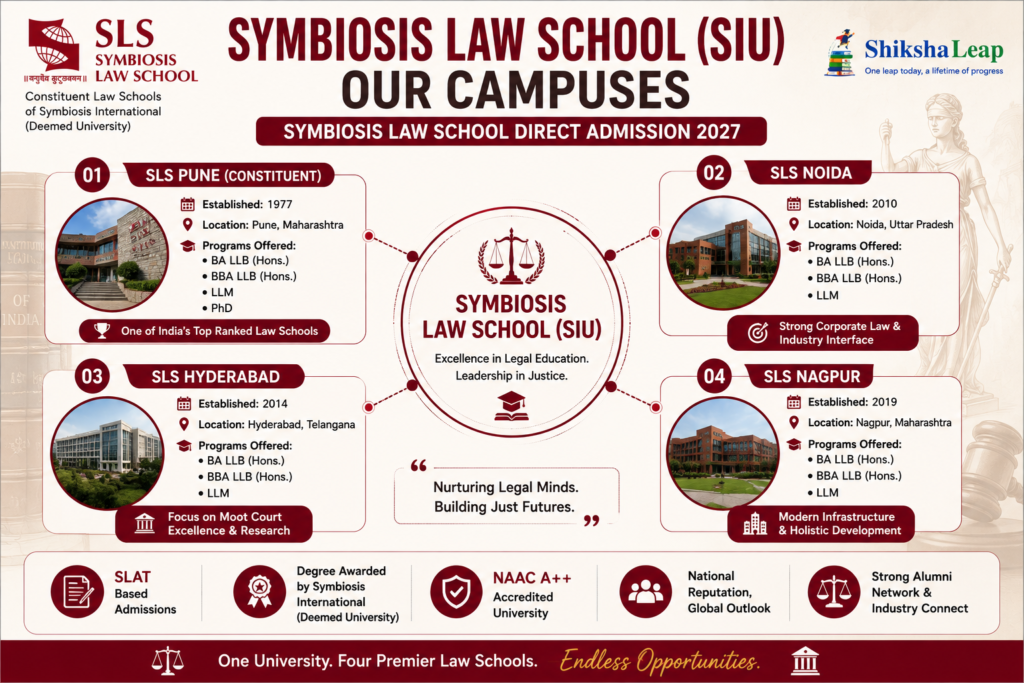
SLS is not one campus but a network of campuses, they are mentioned below in the image.
All campuses belong to SIU and the same SLAT-based admissions process is used, but the cutoffs and competitiveness of admissions vary widely by location. SLS Pune Viman Nagar is the most sought after and the SLAT cut-off is the toughest of all the campuses.
Symbiosis Law School Pune is one of the top law colleges in Pune and is always ranked among the best private colleges. Symbiosis Law School Noida comes in every second “top law colleges in Delhi-NCR” conversation as a credible private option if you’re a student in Delhi-NCR and didn’t get an NLU rank. And in the larger landscape of top law colleges in Maharashtra, Symbiosis Law School Pune occupies a unique space by offering a campus-based, SIU-integrated legal education that the older, more established Pune law colleges don’t quite replicate.
Courses Offered at Symbiosis Law School
Here are all the law courses offered at Symbiosis Law Schools as per the official SIU and SLS programme pages:
| Course Type | Programme Name | Duration |
| Undergraduate | B.A. LL.B. | 5 Years |
| Undergraduate | B.B.A. LL.B. | 5 Years |
| Undergraduate | B.Com. LL.B. | 5 Years |
| Undergraduate | LL.B. | 3 Years |
| Postgraduate | LL.M. | 1 Year |
| Doctoral | Ph.D. in Law | Variable |
Symbiosis Law School Direct Admission
When students search for “direct admission in Symbiosis Law School” or “Symbiosis Law School direct admission,” they generally have two things in mind. Let’s address both directly.
The first meaning — “How do I apply to Symbiosis Law School directly?”
This is very simple. The admissions to the Symbiosis Law School are done through the official admissions portal of SIU. You register, fill Symbiosis Law School application form, appear for SLAT, and if shortlisted, go through a Personal Interaction (PI) round. “That’s it.
The second meaning — “Can we get into Symbiosis without SLAT?”
Let’s be honest here, SLAT is mandatory for the standard admission process. SLAT is the official entry point for the selection procedure. There is no official admission to Symbiosis Law School without an entrance exam.
So what is there and what some people call “direct admission in Symbiosis Law School” is the NRI category which we will discuss in the next section.
Management Quota at Symbiosis Law School
Symbiosis Law School is part of Symbiosis International (Deemed University), a deemed-to-be university, and not an affiliated college under Maharashtra’s state DTE/FRC framework that governs management quota at SPPU-affiliated colleges. Which means the institutional quota system, which is regulated by the FRC, does not apply here.
There are no donation-based seats. To know about “Symbiosis Law School management quota seats”, or if “guaranteed Symbiosis Law School seats”, “Discretionary Quota” exist or not, Contact ShikshaLeap.
The Symbiosis NRI Quota is the actual and documented route for admission under the management quota at Symbiosis Law School which is explained below.
NRI Quota at Symbiosis Law School
Symbiosis Law School does have seats under the NRI category for students who qualify under NRI/OCI/PIO definition. Symbiosis Law School NRI quota admission is done through SIU’s main admission office and fee structure for NRI quota is different than the general category.
Critically and this is the same pattern we see across all SIU programmes, NRI applicants also go through SLAT and the PI process. Fee structure changes for NRI Quota at Symbiosis Law School.
This is a valid documented route for students who are genuinely NRI/OCI/PIO with specific Symbiosis Law School NRI Quota seat allotments.
The Symbiosis NRI quota fees are higher than general category fees and you can confirm the same directly with ShikshaLeap as the fees are revised periodically.
Symbiosis Law School Admission Process: Step by Step
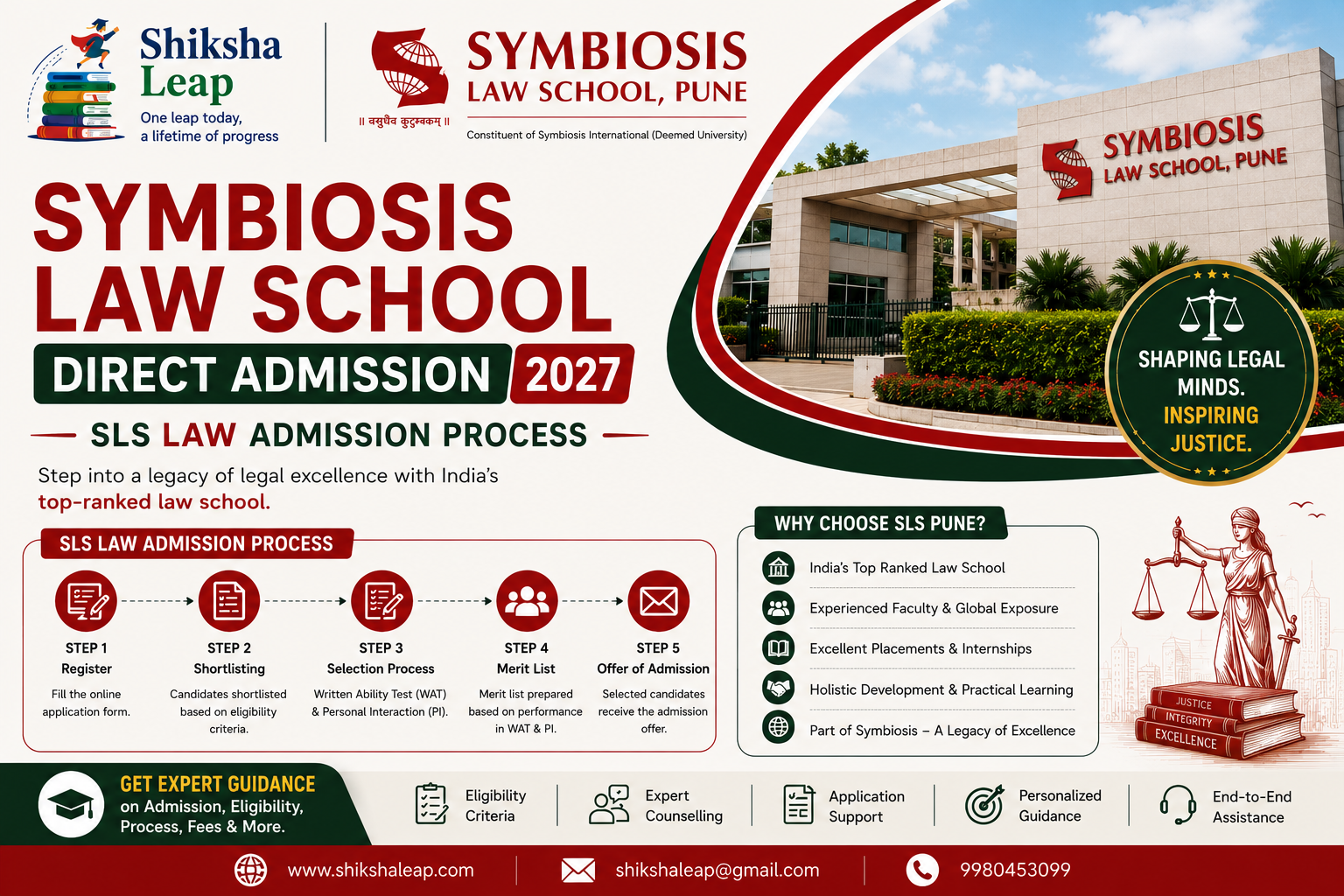
There are 4 steps to SLS LAW Admission Process, they are:
1. Symbiosis Law School Eligibility Criteria
- BA LLB, BBA LLB & B.Com LLB : 10+2 (Class 12) from a recognized board with minimum 50% aggregate
- No age limit for 5-year integrated programmes
- It is a program for students taking admission just after Class 12, it is not a post graduate law degree
2. SLAT (Symbiosis Law Admission Test)
SLAT is a 60-minute online exam covering:
- Logical Reasoning
- Legal Reasoning
- Analytical Reasoning
- Reading Comprehension
- General Knowledge
SLAT will be held on 19th & 26th December, 2026 for the upcoming academic year. The registration process will start on 21st August, 2026 through SIU’s official portal symbiosis.ac.in.
3. After SLAT: Personal Interaction (PI)
Shortlisted candidates are called for a Personal Interaction round, the usual final selection stage across SIU’s institutes. The PI for SLS measures clarity of communication, general awareness, motivation for law and basic aptitude for legal profession. For fresh 12th grade graduates (the primary intake for SLS, since these are 5-year UG programmes), the PI often looks at why law, what areas of law interest you and general current affairs. Based on the 70 % weightage of scores for SLAT and 30% for PI, the Merit lists will be declared.
4. Campus and Programme Preference
At the time of registration, candidates select their preferred SLS campus and programme (BA LLB, BBA LLB or B.Com LLB) After PI, seats are distributed based on SLAT score, PI performance and campus/programme availability.
Symbiosis Law School Fees Structure
1. Symbiosis Law School Fees for Indian Students
The total fees at Symbiosis Law School are given below. It is significantly cheaper than many comparable branded standalone private law schools.
| Programme Name | Campus | Fees (approx.) |
| B.A. LL.B. | Symbiosis Law School (SLS), Pune | Academic Fee per annum: ₹5,06,000 Institute Deposit (one-time, refundable): ₹20,000 |
| Symbiosis Law School (SLS), Noida | Academic Fee per annum: ₹4,11,000 Institute Deposit (one-time, refundable): ₹20,000 | |
| Symbiosis Law School (SLS), Hyderabad | Academic Fee per annum: ₹3,95,000 Institute Deposit (one-time, refundable): ₹20,000 | |
| Symbiosis Law School (SLS), Nagpur | Academic Fee per annum: ₹4,11,000 Institute Deposit (one-time, refundable): ₹20,000 | |
| B.B.A. LL.B. | Symbiosis Law School (SLS), Pune | Academic Fee per annum: ₹5,06,000 Institute Deposit (one-time, refundable): ₹20,000 |
| Symbiosis Law School (SLS), Noida | Academic Fee per annum: ₹4,11,000 Institute Deposit (one-time, refundable): ₹20,000 | |
| Symbiosis Law School (SLS), Hyderabad | Academic Fee per annum: ₹3,95,000 Institute Deposit (one-time, refundable): ₹20,000 | |
| Symbiosis Law School (SLS), Nagpur | Academic Fee per annum: ₹4,11,000 Institute Deposit (one-time, refundable): ₹20,000 | |
| B.Com. LL.B. | Symbiosis Law School (SLS), Pune | Academic Fee per annum: ₹5,06,000 Institute Deposit (one-time, refundable): ₹20,000 |
| LL.B. | Symbiosis Law School (SLS), Pune | Academic Fee per annum: ₹3,39,000 Institute Deposit (one-time, refundable): ₹20,000 |
| LL.M. | Symbiosis Law School (SLS), Pune | Academic Fee per annum: ₹2,70,000 Institute Deposit (one-time, refundable): ₹10,000 |
| Symbiosis Law School (SLS), Noida | Academic Fee per annum: ₹1,96,000 Institute Deposit (one-time, refundable): ₹10,000 | |
| Symbiosis Law School (SLS), Hyderabad | Academic Fee per annum: ₹1,65,000 Institute Deposit (one-time, refundable): ₹10,000 | |
| Symbiosis Law School (SLS), Nagpur | Academic Fee per annum: ~8144₹1,62,350 Institute Deposit (one-time, refundable): ₹10,000 |
3. Symbiosis Law School NRI Quota Fees
The fees for the students under the NRI category is much higher. Symbiosis Law School NRI Quota Fees is as follows:
| Programme Name | Campus | Fees (approx.) |
| B.A. LL.B. | Symbiosis Law School (SLS), Pune | Academic Fee per annum: $8,650 Institute Deposit (one-time, refundable): $275 |
| Symbiosis Law School (SLS), Noida | Academic Fee per annum: $7,700 Institute Deposit (one-time, refundable): $275 | |
| Symbiosis Law School (SLS), Hyderabad | Academic Fee per annum: $7,400 Institute Deposit (one-time, refundable): $275 | |
| Symbiosis Law School (SLS), Nagpur | Academic Fee per annum: $7,700 Institute Deposit (one-time, refundable): $275 | |
| B.B.A. LL.B. | Symbiosis Law School (SLS), Pune | Academic Fee per annum: $8,650 Institute Deposit (one-time, refundable): $275 |
| Symbiosis Law School (SLS), Noida | Academic Fee per annum: $7,700 Institute Deposit (one-time, refundable): $275 | |
| Symbiosis Law School (SLS), Hyderabad | Academic Fee per annum: $7,700 Institute Deposit (one-time, refundable): $275 | |
| Symbiosis Law School (SLS), Nagpur | Academic Fee per annum: $7,700 Institute Deposit (one-time, refundable): $275 | |
| B.Com. LL.B. | Symbiosis Law School (SLS), Pune | Academic Fee per annum: $8,650 Institute Deposit (one-time, refundable): $275 |
| LL.B. | Symbiosis Law School (SLS), Pune | Not published |
| LL.M. | Symbiosis Law School (SLS), Pune | Academic Fee per annum: $4,700 Institute Deposit (one-time, refundable): $150 Administrative Fees (Non Refundable) to be paid: $550 |
| Symbiosis Law School (SLS), Noida | Academic Fee per annum: $3,500 Institute Deposit (one-time, refundable): $150 | |
| Symbiosis Law School (SLS), Hyderabad | Academic Fee per annum: $3,275 Institute Deposit (one-time, refundable): $150 | |
| Symbiosis Law School (SLS), Nagpur | Academic Fee per annum: $3,600 Institute Deposit (one-time, refundable): $150 |
Note: These are tuition figures. Charges for hostel, mess etc are extra and varies from campus to campus. SLS Pune has its own residential facilities on or near the campus whereas SLS Noida and other campuses have their own arrangements.
How to get admission in Symbiosis Law School without CLAT?
Let’s put a pin in the CLAT question because this is the one that trips up the most students.
You need not to take CLAT for Symbiosis Law School. CLAT scores are not accepted nor required. SLS doesn’t depend on whether you have cleared the cut off of CLAT or not. And if you haven’t taken the CLAT at all, it doesn’t affect your SLS application.
Only SLAT is the entrance exam relevant for your entry into SLS. The exam is different, registration is done separately, and evaluated by the SIU’s admissions committee and not by the Consortium of NLUs.
This means two things: Firstly, students preparing for CLAT and looking at SLS as a backup need to register for SLAT separately because it is a separate exam on a separate timeline. Second: Students who opted out of NLUs and are looking to get a quality private law education, can have SLAT as their entire prep strategy and never have to worry about CLAT.
How ShikshaLeap helps Symbiosis Law School aspirants?
Symbiosis Law School admission guidance at ShikshaLeap begins by making sure that students are using the right information on which exam to prepare for, which campus to aim for and what the PI evaluation actually is.
Symbiosis management quota guidance, when this question reaches us, we answer it like we have in this article – honestly, clearly and with a redirection to the preparation that actually matters.
ShikshaLeap — One Leap Today. A Lifetime of Progress.
➡️ Start your SLS journey with confidence — Let ShikshaLeap guide you every step of the way!
ShikshaLeap wishes each and every Aspirant, best of Luck for your Journey! You already won the day to decide to go for it so let not anything stop you from achieving your goal and if you have any doubt regarding anything maybe it is the entrance exam, interview prep or profile building we are there as your Friend, Philosopher & Guide!
Let’s TALK @ 9980453099
FAQs: Symbiosis Law School Admission
Q1. Is it possible to get direct admission in Symbiosis Law School? The only published route for official admission is SLAT + PI.
Q2. Is CLAT score accepted by SLS? No CLAT is for NLUs. SLS is conducting Symbiosis Law Admission Test (SLAT). These are distinct exams requiring distinct registrations.
Q3. Are there any management quota seats in Symbiosis Law School? No. SLS is a part of Symbiosis International (Deemed University) and does not fall under the state regulated management quota system.
Q4. Is there an NRI quota in SLS? Yes. NRI/OCI/PIO category students can apply through a separate fee structure. The same SLAT + PI process applies — the NRI category changes fees, not the academic evaluation.
Q5. What is the eligibility for BA LLB and BBA LLB under SLS? Minimum 50% aggregate in 12th Class, No age restriction for 5-year integrated programmes.
Q6. What is the fee structure for Symbiosis Law School? Fees are ₹2.0-5.0 lakhs per year depending on what campus or course you have selected.
Q7. How competitive is SLS Pune in comparison with other campuses? SLS Viman Nagar Pune is the most competitive. SLS Noida and Hyderabad have slightly lower cut-offs but still carry the SIU/ Symbiosis brand value.
Q8. How ShikshaLeap can help for SLS admission? For the evaluation format of SLS, we provide SLAT preparation (section-wise plans), campus and programme selection and PI coaching. We also help students who are confused between CLAT and SLAT to know which exams are applicable for which colleges.
Also Read About:
- IMT Ghaziabad Direct Admission 2027 Guide
- Management Quota in NMIMS Mumbai 2027: MBA Guide
- Direct Admission in Symbiosis Pune 2027: Management Quota Seats
- GIM Goa Management Quota 2027: Direct Admission Process
- Direct Admission in IMI Delhi 2027: PGDM Admission Process
If you’re planning to pursue Engineering and want to explore Top Engineering colleges, courses, and admission options, Visit: Direct Admission to Top Private Engineering Colleges in India | Shiksha Tech
OR
If you’re planning to pursue MBBS and want to explore Top MBBS Colleges, courses, and admission options, Visit: Direct Admission to Top Medical Colleges in India | Dr. Shiksha