

Most MBA guides start with a number. The founding year. The NIRF rank. The CAT cutoff. The fee.
For Masters’ Union Gurgaon, every one of those numbers does something unusual: it either confuses you or surprises you.
Founded: 2020. Four years before most B-schools have their first batch, Masters’ Union was already publishing placement reports that made established institutions uncomfortable.
NIRF rank: Not in the official management category — because Masters’ Union is too new to have the longitudinal data NIRF requires. Some MBA forums rank it alongside ISB Hyderabad in placement conversations. Neither of those facts can both be right, and yet somehow they coexist.
CAT cutoff: Optional. Not required. You can get into Masters’ Union’s flagship programme without ever writing CAT. Which either sounds like a red flag or like a fundamentally different philosophy about how talent should be evaluated. (It’s the second one.)
Fee: ₹33.65 lakhs. For a five-year-old private institution in Gurugram. Higher than MDI Gurgaon. Comparable to ISB Hyderabad at a fraction of ISB’s age and none of ISB’s global ranking.
Average placement 2025: ₹33.39 LPA. Highest: ₹1.28 crore.
If you’re reading this because you typed “Masters’ Union Gurgaon management quota admission” — you’re about to discover that the management quota question is almost beside the point here. Because Masters’ Union’s entire admission philosophy is already built around evaluating your whole profile, your communication ability, your professional trajectory, and your thinking under pressure. There’s no room in that model for a donation seat, and frankly, no institutional incentive to offer one.
But we’ll answer the Masters’ Union Gurgaon management quota question properly. And then we’ll spend the rest of this article doing something more useful: explaining what Masters’ Union actually is, who it’s built for, and whether it belongs on your shortlist in 2026.
We’re ShikshaLeap. We help students get into B-schools through strategy and honest preparation. Call us at 9980453099 or write to shikshaleap@gmail.com — whether Masters’ Union is your first choice or your fifth, we’ll tell you what your application actually needs.
Masters’ Union Gurgaon Management Quota Question
Masters’ Union does not offer management quota seats, corporate quota seats, or any form of payment-based direct admission. Their official admissions process — described in detail at https://www.mastersunion.org/admissions is multi-stage, profile-heavy, and includes a video essay, an online aptitude test, an AI-based assessment, and a Personal Interview conducted by Masters’ Union alumni and leadership members.
The acceptance rate at Masters’ Union is approximately 12–15% — which is more selective than many IIM programmes on a percentage basis. That selectivity is not achieved by running parallel donation-seat operations on the side. It’s achieved by a genuinely rigorous application review that takes weeks per candidate.
What’s particularly ironic about the “management quota” search for Masters’ Union: this institution is arguably the most profile-driven admission process in this entire article series. They evaluate your video essay. They run an AI-based critical thinking assessment on interview day. They interview you with alumni. None of that infrastructure exists to be bypassed by a fee.
No management quota admission in Masters’ Union. No direct admission. No backdoor. If someone offers you one, they’re charging for nothing. The actual process is described below, and it’s actually more interesting than most people expect.
Need Help with Your Masters’ Union Gurgaon Management Quota Admission?
Connect with ShikshaLeap today for expert guidance and personalized assistance to choose the course that best aligns with your career goals.
Call us at: +91-9980453099
Write to us at: shikshaleap@gmail.com
What Masters’ Union Gurgaon Actually Is — Because This Requires Explanation
Masters’ Union was founded in 2020 with a premise that is genuinely different from every other management institution in this series: traditional MBA education, built around academic faculty teaching theory in classrooms, is increasingly misaligned with what industry actually needs from management graduates.
So they built something else.
The faculty at Masters’ Union consists of over 200 industry practitioners — active professionals from companies like McKinsey, Microsoft, Google, Mastercard, Sequoia Capital, and Goldman Sachs who teach actual courses. Not as guest lecturers. As faculty. The Executive-in-Residence programme brings senior executives into the classroom as semester-long instructors — people who are currently making the decisions that MBA graduates will be asked to make five years from now.
The Best MBA for Entrepreneurs in India
The campus is not in a quiet educational zone on the outskirts of the city. It is located in DLF Cyber City, Gurugram — arguably the most commercially dense geography in India outside of South Mumbai. The companies that recruit Masters’ Union graduates are not down the expressway or across town. They are, in some cases, in the building next door.
The flagship programme is 16 months long — not two years. This is not a shortcut. It is a deliberate programme design that compresses a high-intensity curriculum into a format that the institution believes better serves mid-career professionals who cannot take two years out of their working lives.
Is it an IIM? No. Is it ISB? Not yet. Is it something new that doesn’t fit cleanly into either category? Yes. And that is — for the right candidate — exactly the point.
When people talk about the best private university in Delhi-NCR or the top management college in Gurgaon, Masters’ Union is increasingly entering that conversation — not through rankings or accreditation history, but through placement data and the specific quality of roles its graduates land. It is the fastest-growing management brand in the NCR’s private B-school ecosystem, and ignoring it because it’s only five years old is a mistake that several serious MBA candidates made in 2022 and regretted by 2024.
Best MBA Colleges in Delhi NCR 2026: Your Gateway to Leadership and Success
PGP Programmes at Masters’ Union Gurgaon: More Than Just One MBA
Masters’ Union’s portfolio has expanded significantly since its first batch. For 2026 admissions:
PGP-TBM (Post Graduate Programme in Technology and Business Management): The 16-month flagship. Designed for candidates with at least 1 year of work experience. This is not a general management programme — the “Technology” component is not decorative. Every element of the curriculum is designed around the intersection of business decision-making and technology-driven change. Specialisations include Product Management, Data Analytics, FinTech, and Strategy. Total fee: ₹33.65 lakhs.
PGP-TBM YLC (Young Leaders Cohort): A 24-month version of the PGP-TBM, specifically designed for fresher candidates or those with 0–12 months of work experience. Masters’ Union created this because the 16-month programme assumes a base of professional context that fresh graduates don’t have. The YLC builds that context into the programme design itself. Total fee: ₹34 lakhs. A small premium over the flagship — justified by the additional curriculum depth for the profile it serves.
Executive PGP: A 1-year programme for professionals with a minimum of 5 years of post-qualification work experience. Admission is based on profile shortlisting and Personal Interview — no entrance exam required. For senior professionals who want the Masters’ Union credential and network without the full PGP-TBM commitment.
Undergraduate Programmes (4-Year): Masters’ Union offers India’s first undergraduate degree in Technology and Business Management, plus newer programmes in Psychology & Marketing and Data Science & AI. Annual UG fee: approximately ₹10.80 lakhs. UG admission is based on CUET, SAT, JEE, IPMAT, or Masters’ Union’s own MUSAT, followed by a holistic evaluation.
MDI Gurgaon Direct Admission 2026 through Quota seats
Masters’ Union Gurgaon Admission Process: Seven Steps That Test More Than Your CAT Score
Masters’ Union’s PGP-TBM admission process is arguably the most multi-dimensional in this series. Here’s what it looks like:
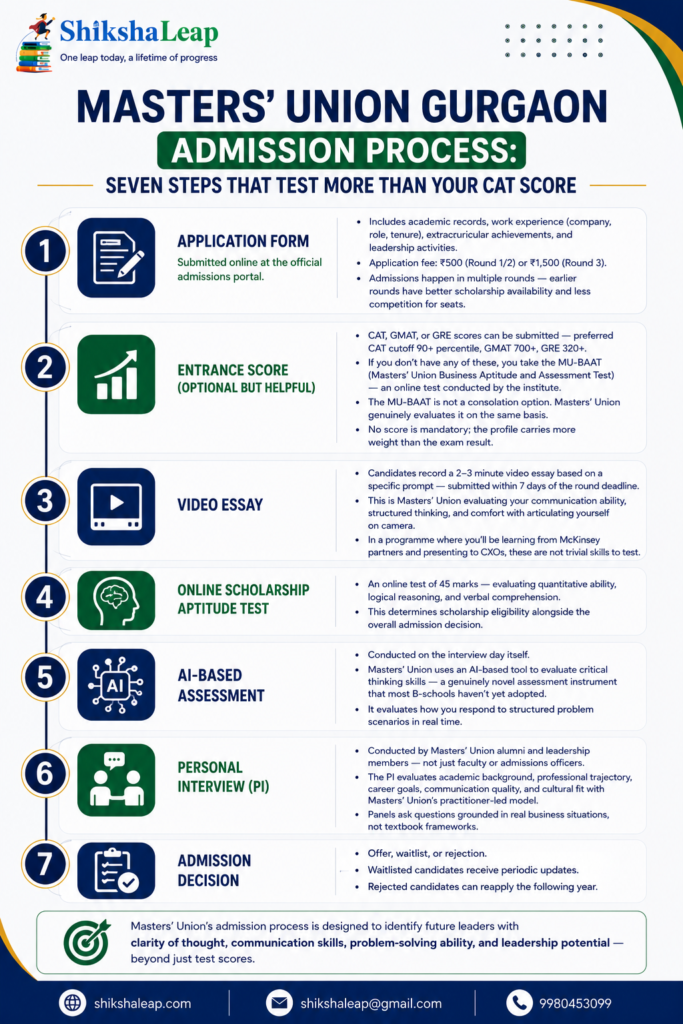
Masters’ Union interview preparation tips: Know your work experience inside out — the alumni who interview you have done similar jobs and can tell the difference between a candidate who actually delivered outcomes and one who recited job descriptions. Have a clear answer to “Why Masters’ Union and not ISB?” Have something genuine to say about where technology and business intersect in your career plans. And please — practice your video essay before submitting it. Three minutes of meandering is three minutes of first impression, and not a good one.
How to Get Direct Admission in Great Lakes Gurgaon (GLIM) by Management / NRI Quota
Masters’ Union Gurgaon PGP Fees: Round-Based Structure and Scholarship Reality
Masters’ Union’s fee structure has a feature that most B-schools don’t use round-based pricing. Earlier rounds don’t just have more seats available — they come with better scholarship opportunities.
| Programme | Total Fee | Notes |
| PGP-TBM | ₹33.65 Lakhs | 16 months; 1+ year work-ex |
| PGP-TBM YLC | ₹34.00 Lakhs | 24 months; fresher-friendly |
| Executive PGP | Lower (1 year) | 5+ years work-ex; profile-based |
| UG TBM / Psych & Mktg | ₹10.80 Lakhs/year | 4-year undergrad |
At ₹33.65 lakhs, the PGP-TBM fee is higher than MDI Gurgaon (₹26.55 lakhs), SPJIMR Mumbai (₹26.50 lakhs), and every other institution in this series except ISB Hyderabad. This is not a typo. For a five-year-old school, that’s a significant fee to ask.
The justification lies in the placement outcomes — and we’ll get to those. But practically: apply in Round 1 or Round 2 if possible. The scholarship aptitude test can offset meaningful portions of tuition for qualifying candidates, and scholarship availability diminishes as rounds close.
Hostel: Optional; located 7–8 km from campus in residential Gurugram, with shuttle service. Both AC and non-AC rooms in single and triple-sharing formats. Hostel fee is charged separately and not included in the tuition figure above.
Masters’ Union Gurgaon Cohort Profile: Who You’ll Actually Be Sitting Next to
This is where Masters’ Union gets genuinely interesting from a learning environment perspective — and it’s a detail that admission articles routinely underreport.
2025 PGP Batch:
- 233 students total
- 8 Chartered Accountants in the cohort
- 11 founders (people who have already started companies)
- 31% female representation
- 3.2 years average work experience
- Presidential Awardees and IIT graduates in the cohort
When Masters’ Union talks about a “practitioner-led” education, this extends to the classroom itself. You’re not learning case studies about startup founders next to 22-year-olds who just finished their engineering degree. You are sitting next to actual founders, CAs, engineers with four years of MNC experience, and Presidential Award recipients. The peer learning is a genuine differentiator — not a marketing line.
The Masters’ Union cohort profile is one of the reasons the interview process is so thorough. They are curating a room that is supposed to make each other better, not just a batch that clears a score threshold.
Admission in ISB Hyderabad & Mohali: The Ultimate 2025 Guide to One of India’s Best MBAs
Masters’ Union Gurgaon Placement Story: Can a Five-Year-Old School Really Deliver This?
Let’s look at the numbers — and yes, they are remarkable for an institution of this age.
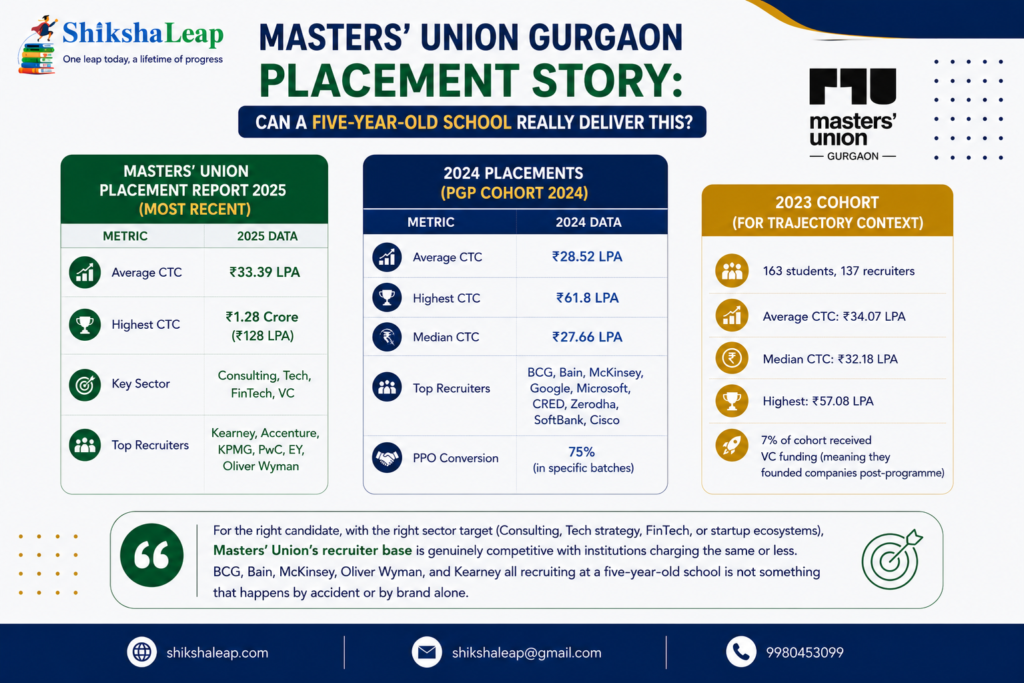
Three data points in three years — and the trajectory is consistent: average CTC between ₹28.52 and ₹34.07 LPA, consultancies and tech majors as primary recruiters, and a growing PPO culture.
The honest caveat: Masters’ Union batches are small (163–233 students). Placement averages at small batch sizes are more volatile than at large batches. A few very high offers (₹1.28 crore in 2025, ₹61.8 LPA in 2024) can significantly move the average. The median — ₹27.66 LPA in 2024 — is a more conservative but still competitive number.
Need Help with Your Masters’ Union Gurgaon Management Quota Admission?
Connect with ShikshaLeap today for expert guidance and personalized assistance to choose the course that best aligns with your career goals.
Call us at: +91-9980453099
Write to us at: shikshaleap@gmail.com
Masters’ Union vs ISB Hyderabad: The Comparison That Comes Up Every Time
Both are premium, practitioner-oriented, full-fee private institutions with strong consulting and tech recruiter bases. The comparison is flattering to Masters’ Union and genuinely useful for a candidate making this specific decision.
| Parameter | Masters’ Union | ISB Hyderabad |
| Founded | 2020 | 2001 |
| Programme Length | 16 months (PGP-TBM) | 12 months (PGP) |
| Total Fee | ₹33.65 Lakhs | ~₹43–48 Lakhs |
| Average Placement | ₹33.39 LPA (2025) | ~₹34–38 LPA |
| Highest Package | ₹1.28 Crore (2025) | ₹1+ Crore (annual) |
| GMAT Requirement | Optional (MU-BAAT accepted) | Typically required (~720+) |
| Global Ranking | Not yet ranked globally | FT Global MBA Top 30 |
| Location | DLF Cyber City, Gurugram | Hyderabad / Mohali |
| Accreditation | AICTE | AACSB, AMBA |
| Work-Ex Required | 1+ year | 2–3 years typically |
The answer is not “one is better than the other.” The answer is “which one is built for where you’re going?”
ISB Hyderabad Direct Admission 2026: Indian School of Business – The Architecture of Excellence
How ShikshaLeap Approaches Masters’ Union Applications?
The Masters’ Union admission process rewards preparation in a very specific set of skills — video communication, structured thinking under AI assessment, and the ability to narrate a professional journey convincingly to alumni interviewers.
These are not skills that improve by reading MBA forums at midnight. They improve through practice.
Here’s what ShikshaLeap does for Masters’ Union aspirants specifically:
- Application Positioning
- MU-BAAT / Scholarship Aptitude Test Preparation
- AI Assessment Awareness
- PI Preparation with the Alumni Angle
- Programme Selection and Round Strategy
📞 Call ShikshaLeap at 9980453099 ✉️ Write to us at shikshaleap@gmail.com Masters’ Union is genuinely new. Not everyone understands how to position for it yet. We do. One conversation about your profile could be the difference between a waitlist and an offer. ShikshaLeap — One Leap Today. A Lifetime of Progress.
Masters’ Union Gurgaon — For the Right Candidate
Masters’ Union is not for everyone. The fee is high for a school with five years of placement data. The global accreditations are not yet in place. The alumni network is growing but not yet the depth of ISB’s or MDI’s.
But for a candidate who wants to work in Consulting, Tech strategy, FinTech, or the startup ecosystem — who has 1–4 years of strong professional experience — who genuinely wants to be taught by the people currently making decisions at McKinsey and Microsoft rather than academics who study them — and who wants to do that in the middle of India’s corporate capital, on a 16-month programme that gets them back in the market faster:
Masters’ Union Gurgaon is one of the most interesting management education bets in India right now.
No management quota. No shortcut. No backdoor. A 12–15% acceptance rate, a video essay, an AI assessment, and an interview with someone who used to sit where you’re sitting.
Prepare properly. Apply early. Come in knowing exactly what you want from it.
➡️ Start your Masters’ Union Gurgaon journey with confidence — Let ShikshaLeap guide you every step of the way!
ShikshaLeap wishes each and every Aspirant, best of Luck for your Journey! You already won the day to decide to go for it so let not anything stop you from achieving your goal and if you have any doubt regarding anything maybe it is the entrance exam, interview prep or profile building we are there as your Friend, Philosopher & Guide!
Let’s TALK @ 9980453099
FAQs About Masters’ Union PGP Management Quota Admission
Q1. Is there a management quota at Masters’ Union Gurgaon?
No. Admission is strictly profile-based, multi-stage, and merit-driven. The acceptance rate is 12–15%. No donation-based or quota admission exists.
Q2. Is CAT mandatory for Masters’ Union PGP admission?
No. CAT (preferred 90+ percentile), GMAT (700+), and GRE (320+) are accepted but not mandatory. Candidates without these scores take the MU-BAAT (Masters’ Union Business Aptitude and Assessment Test) conducted by the institute.
Q3. What is the total fee for Masters’ Union PGP-TBM?
₹33.65 lakhs for the 16-month PGP-TBM. ₹34 lakhs for the 24-month YLC (Young Leaders Cohort). Both are all-inclusive tuition figures; hostel is charged separately.
Q4. What work experience is required for Masters’ Union?
PGP-TBM requires minimum 1 year of work experience. PGP-TBM YLC is designed for candidates with 0–12 months of experience. Executive PGP requires 5+ years.
Q5. What is the Masters’ Union acceptance rate?
Approximately 12–15%, making it one of the more selective institutions in this series on a percentage basis.
Q6. How does Masters’ Union compare with ISB Hyderabad?
ISB has stronger global accreditation (AACSB/AMBA), higher average placements (~₹34–38 LPA), and a more established international brand. Masters’ Union offers a lower total fee (₹33.65 L vs ISB’s ₹43–48 L), Gurugram location advantage, a tech-forward curriculum, and a more accessible entry point (MU-BAAT vs GMAT 720+). ISB is the stronger choice for international career goals; Masters’ Union is increasingly competitive for India-based Consulting, Tech, and startup roles.
Q7. What is the Masters’ Union Executive-in-Residence programme?
Senior executives from companies like McKinsey, Microsoft, Google, and Sequoia Capital serve as semester-long faculty — teaching actual courses, not just delivering one-off guest lectures. This is central to Masters’ Union’s practitioner-led curriculum model.
Also read About:
- IIFT Delhi Management Quota Admission: Why the Shortcut Question Misses the Point Entirely
- LBSIM Delhi Management Quota Admission: The Smart Candidate’s Guide to Getting In
- FMS Delhi Management Quota Admission: The Arithmetic That Changes Everything
- BIMTECH Noida Management Quota Admission: BIMTECH PGDM Admission
- MDI Gurgaon Management Quota Admission: Three Questions, Three Honest Answers, One Definitive Guide
If you’re planning to pursue Engineering and want to explore top Engineering colleges, courses, and admission options, Visit: Direct Admission to Top Private Engineering Colleges in India | Shiksha Tech
OR
If you’re planning to pursue MBBS and want to explore Top MBBS Colleges, courses, and admission options, Visit: Direct Admission to Top Medical Colleges in India | Dr. Shiksha