
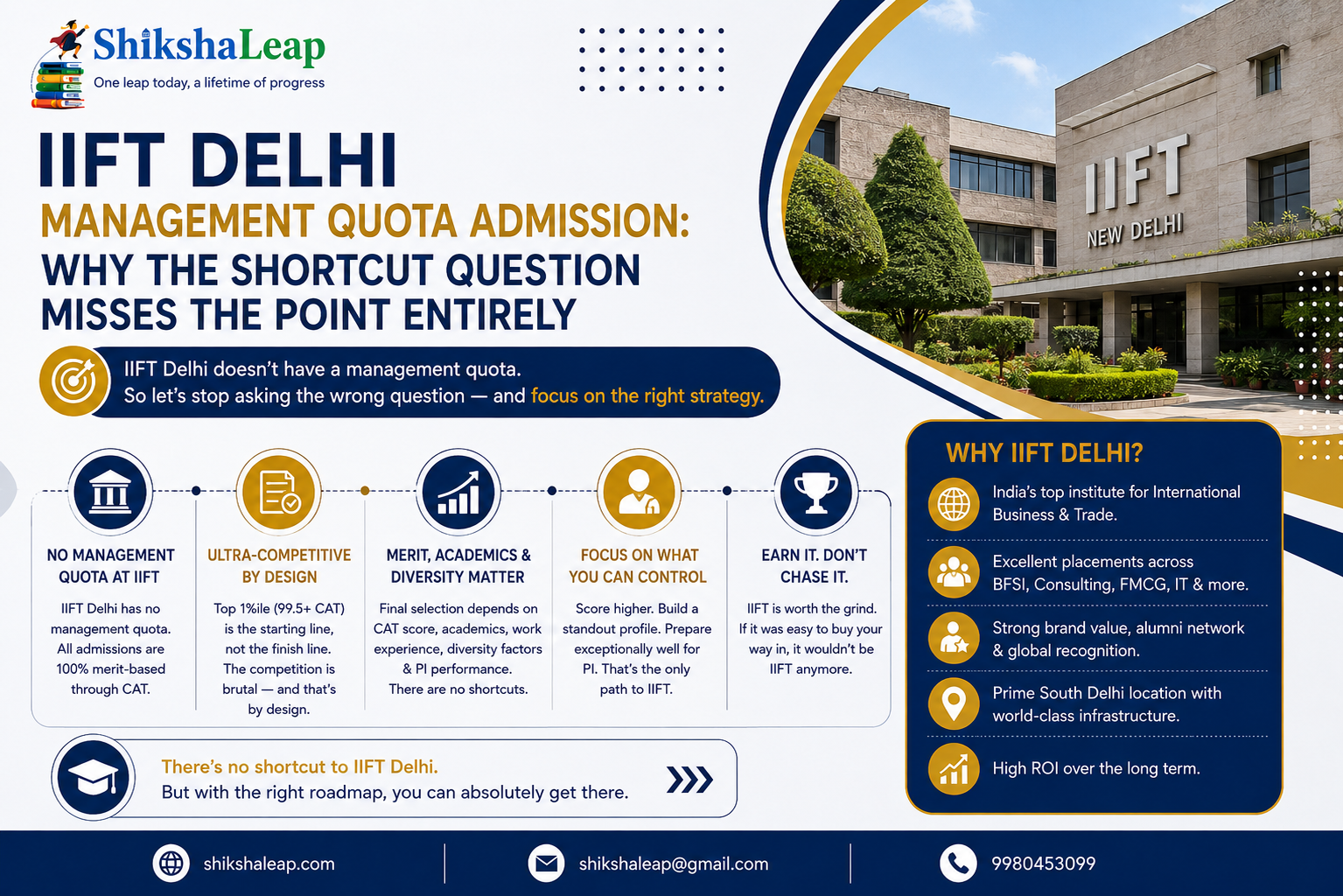
Here is a fact that most MBA guides won’t tell you: three of Delhi’s most respected B-schools sit within walking distance of each other in Qutab Institutional Area, South Delhi.
IMI Delhi is there. FORE School of Management is there. And right there with them — sharing the same postcode, the same South Delhi corporate proximity, and the same MBA aspirant search traffic — is the Indian Institute of Foreign Trade.
Now, IMI Delhi and FORE Delhi are private institutions. They have management structures, marketing budgets, and consultancy firms helping them run digital ads. IIFT Delhi is a centrally funded deemed university, established in 1963 under the Ministry of Commerce and Industry, Government of India. It trains probationary officers of the Indian Trade Service. It was granted Deemed University status in 2022. It answers, at an institutional level, to the Central Government.
So when someone types “IIFT Delhi management quota admission” into a search bar at midnight — which they absolutely do, every single season — there is a very specific kind of irony at play. You are searching for a backdoor into a government institution that has been building India’s international trade and commerce leadership for over sixty years on a foundation of pure, documented merit.
The answer, in case you need it spelled out: No. There is no management quota at IIFT Delhi. Their own admissions website confirms it without ceremony.
But if you’ll stay with us for the next ten minutes, we’ll tell you something far more useful than that. We’ll tell you why IIFT Delhi is one of the most undervalued management institutions in the country, what it takes to actually get in, and why — if you’re sitting anywhere between a 96 and 99 CAT percentile with a genuine interest in global business — the conversation should stop being about shortcuts and start being about strategy.
We’re ShikshaLeap. We help students get into colleges like IIFT through honest preparation, not false promises. If you want to talk, call us at 9980453099 or write to shikshaleap@gmail.com. The conversation is free. The clarity it brings? Priceless.
First, Let’s Talk About What IIFT Delhi Actually Is
Most MBA aspirants know IIFT Delhi exists. Fewer understand what makes it genuinely singular — not just as one of the top management colleges in Delhi or one of the best management colleges in India, but as a category of institution that has no real equivalent in the country.
IIFT — the Indian Institute of Foreign Trade — was not created to churn out generalist MBAs. It was created in 1963 with a specific mandate: to build a professional cadre capable of leading India’s foreign trade and international commerce. That mission has never changed. It just got more relevant.
In a world where India’s trade policy matters as much as its monetary policy, where global supply chains are being redrawn after COVID and geopolitical realignment, and where every major Indian conglomerate — from Adani to Tata to Reliance — is building international business divisions at scale, a deep specialisation in International Business is no longer niche. It’s strategic.
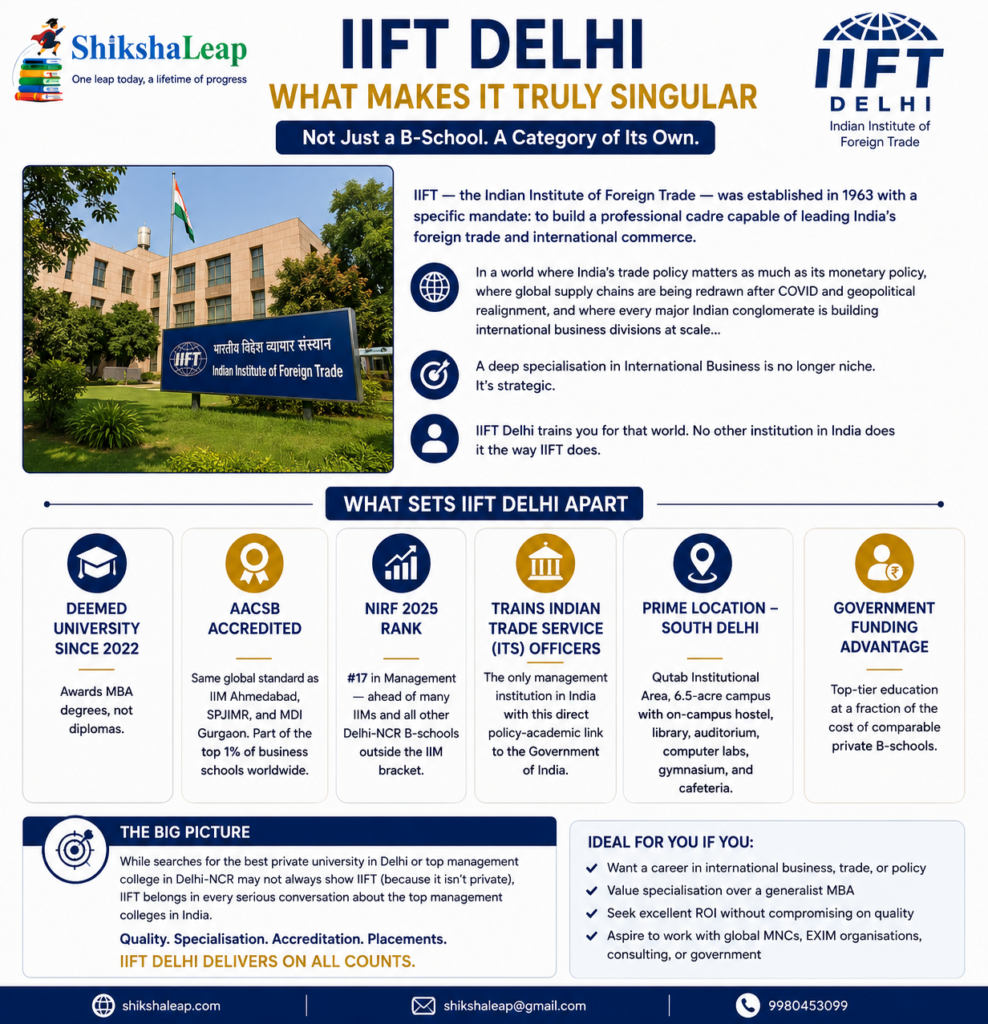
When people search for the best private university in Delhi or the top management college in Delhi-NCR, IIFT often doesn’t appear in those lists because – technically – it isn’t private. But functionally, in terms of quality, specialization, accreditation, and placement outcomes, it belongs in every serious conversation about the top management colleges in India. The government funding tag actually works in your favor: it keeps fees dramatically lower than comparable private institutions, which we’ll get to shortly.
The Best MBA for Entrepreneurs in India
Need Help with Your IIFT Delhi Management Quota Admission?
Connect with ShikshaLeap today for expert guidance and personalized assistance to choose the course that best aligns with your career goals.
Call us at: +91-9980453099
Write to us at: shikshaleap@gmail.com
The Big Change That Nobody’s Talking About
Here’s something that genuinely changed the IIFT Delhi admission game and that a startling number of aspirants are still unaware of:
IIFT Delhi MBA (IB) and MBA (BA) admissions use CAT scores exclusively. The IIFT exam is history. If you prepared for CAT 2026, your score is now your IIFT Delhi ticket – provided it clears the cutoff.
And the 2027–29 batch also comes with three significant rule changes that quietly improve the odds for certain candidate profiles:
- CAT score weightage in Stage 1 shortlisting was reduced from 98 to 90 points. Meaning: your profile now matters more in getting the GD/PI call.
- Work experience was added to Stage 1 with a 5-point weightage. For candidates with even one year of solid professional experience, this is a meaningful bonus.
- Gender diversity weightage in Stage 1 was increased from 2 to 5 points. Female candidates benefit directly from this change.
The message from IIFT’s admissions committee is fairly clear: they want a more diverse, experience-enriched cohort – not just the 99 percentile CAT toppers who happened to be available. That’s a subtle but important shift for anyone building an IIFT application strategy in 2027.
Best MBA Colleges in Delhi NCR 2027: Your Gateway to Leadership and Success
Programmes Offered at IIFT Delhi: What You’re Actually Choosing Between
IIFT Delhi offers two full-time MBA programmes for the 2027–29 batch:
MBA (International Business) — The Flagship
Two years. 240 seats at the Delhi campus. The programme that IIFT was literally built to deliver. Covers International Trade Policy, Global Finance, Foreign Exchange Management, International Marketing, Trade Law, Supply Chain Management, Export-Import Management, and much more.
If you want to understand the MBA (IB) in one sentence: it trains you to operate at the intersection of business strategy and global economics — the layer of thinking that separates middle managers from the people who actually shape how companies move across borders.
The same MBA (IB) programme also runs at IIFT’s Kolkata, Kakinada, and GIFT City campuses, with Delhi being the most competitive and the most sought-after location.
MBA (Business Analytics) — Delhi Campus Only
Two years. Available exclusively at the Delhi campus. Designed for candidates who want to combine data science, analytics, and business intelligence with a management foundation. Targets roles in analytics consulting, product analytics, data strategy, and business intelligence across sectors.
Fee for MBA (BA): ₹17,87,506 – even more affordable than the flagship MBA (IB), with a focused placement track in analytics and tech-facing roles.
Is IIFT Delhi Direct Admission 2027 Possible?
Other Programmes (For Reference): IIFT also offers an MA in Economics (Trade & Finance), Executive PGDM programmes, Certificate Courses, and a doctoral PhD programme. These follow different admission routes and eligibility criteria.
What Does It Take to Actually Get In? (The Cutoff, Decoded)
IIFT Delhi is not the most accessible institution in this list. It’s honest about that. For the Delhi campus MBA (IB), the CAT cutoff for General category candidates runs approximately:
| Category | Overall CAT Percentile | Sectional Cutoff |
| General | 96.7–98+ percentile | 55% per section |
| OBC-NCL / EWS | 90+ percentile | 50% per section |
| SC / ST / PwD | 85+ percentile | 30% per section |
Yes. 98 percentile. For context, that puts you in the top 2% of roughly 3 lakh CAT writers. IIFT Delhi is not where you aim when you’re hoping for the best — it’s where you aim when you’ve prepared like the best.
The important nuance: IIFT’s sectional cutoffs apply at Stage 1 shortlisting. You cannot coast on an outstanding Quant performance while bombing Verbal. All three sections need to clear the bar. This is where many 97-percentile candidates with one weak section find themselves screened out despite a strong overall score.
Is IMI Delhi Direct Admission possible in 2027?
For NRI and international candidates: GMAT scores (taken after January 1, 2024) are accepted for both MBA (IB) and MBA (BA) programmes, followed by a Personal Interview. This is the only legitimate “alternate” entry route for IIFT Delhi – and it still involves a competitive, merit-evaluated process.
IIFT Delhi Admission Process: Geopolitics at 8 AM Is a Real Thing Here
Once shortlisted — which, given the cutoffs, is already a significant achievement — you enter IIFT’s GD/WAT/PI process. And this is where IIFT gets distinctly interesting.
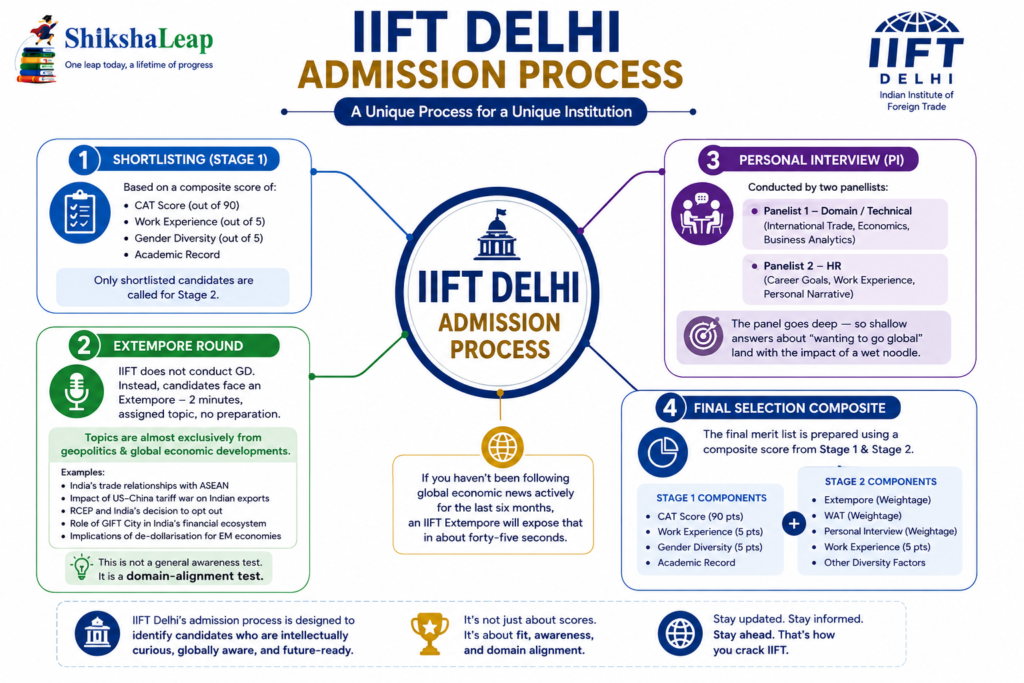
Quip of the day: Candidates who prep for IIFT GD/PI by reading “101 GD Topics” are going to have a very educational two minutes.
How to get Direct Admission in LBSIM Delhi 2027?
Need Help with Your IIFT Delhi Management Quota Admission?
Connect with ShikshaLeap today for expert guidance and personalized assistance to choose the course that best aligns with your career goals.
Call us at: +91-9980453099
Write to us at: shikshaleap@gmail.com
The Fee and ROI Conversation (This Is Where IIFT Gets Genuinely Exciting)
Here is the number that should stop you mid-scroll:
IIFT Delhi MBA (IB) total fee for 2 years: ₹21.82–21.92 lakhs.
Read that again. ₹21.82 lakhs for two years at a NIRF-17 ranked, AACSB-accredited, government-backed institution in South Delhi, with an average placement CTC of ₹31.30 LPA and an on-campus hostel charging ₹45,000–54,000 per year.
To put that in perspective:
| Institution | Total Fee | Avg. Package 2026 | Net Fee after 1 Year Salary |
| IIFT Delhi (MBA IB) | ₹21.82 L | ₹31.30 LPA | Positive in Year 1 |
| MDI Gurgaon (PGDM) | ₹24–26 L | ~₹25 LPA | ~1 year payback |
| SPJIMR Mumbai (PGDM) | ₹26.50 L | ₹33.75 LPA | ~1 year payback |
| IMI Delhi (PGDM) | ₹29.78 L | ₹17.91 LPA | ~1.5–2 year payback |
IIFT’s ROI, when calculated honestly, is the strongest in this comparison. The fee is the lowest of the four. The placement average is the second highest. And the hostel charge — ₹45K–54K per year — is a rounding error compared to what private B-school hostels charge.
If you’re looking for the best management college in Delhi-NCR for return on investment, IIFT Delhi makes an exceptional case that few other institutions can match.
How to get Direct Admission in FORE Delhi through Management Quota and NRI Quota?
IIFT Delhi Scholarship: IIFT offers a Merit-cum-Means Scholarship — a 20% tuition fee waiver awarded to 10% of admitted students after each trimester, for candidates with family income below ₹8 LPA. The scholarship is based on Means (70 weightage) + Merit (30 weightage). Additionally, candidates from SC/ST/PwD categories receive a 50% concession on tuition fees as per Government of India norms. External scholarships including the OP Jindal Scholarship and National Scholarship Portal central government schemes are also available to eligible IIFT students.
IIFT Delhi Placements Records 2024-26 Batch
IIFT Delhi consistently delivers one of the strongest placement-to-fee ratios among the top management colleges in India. Here’s the data:
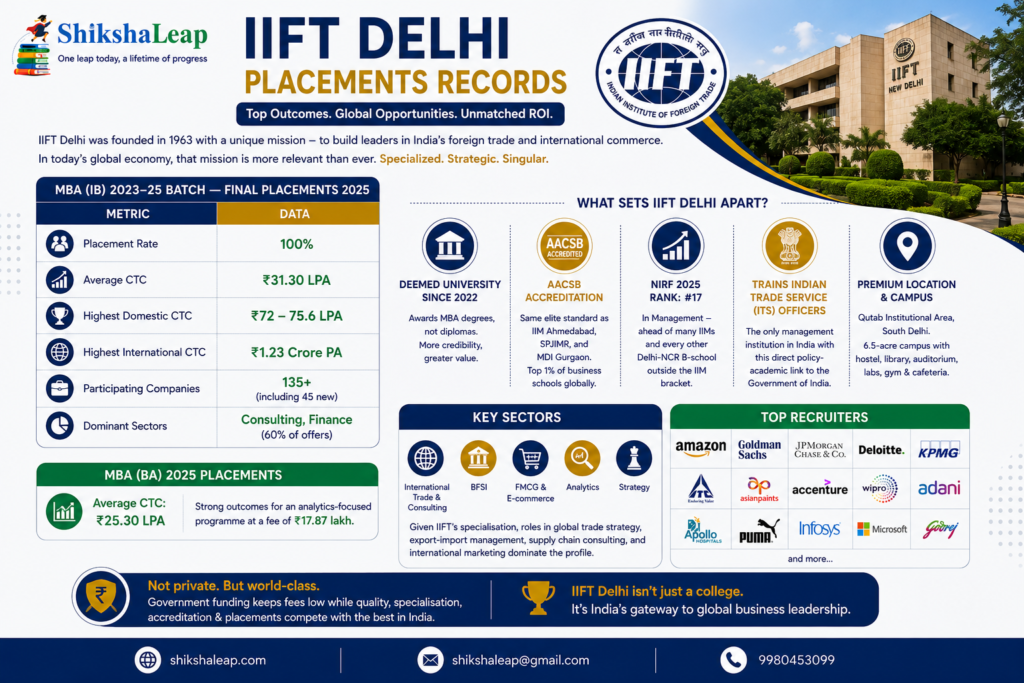
One thing that makes IIFT’s recruiter list distinctive: companies that actively seek candidates with international business knowledge — not just general business acumen — show up here in force. That’s the IIFT effect. The degree signals a specific, valued expertise that general management colleges can’t replicate.
MDI Gurgaon Direct Admission 2027: Is Management Quota an Option?
IIFT Delhi vs MDI Gurgaon vs SPJIMR Mumbai: The Honest Comparison
These three come up together constantly in aspirant college lists. Here’s our take, without the promotional noise:
| Parameter | IIFT Delhi | MDI Gurgaon | SPJIMR Mumbai |
| NIRF 2025 | #17 | #9 | ~#6 |
| Accreditation | AACSB | AACSB, AMBA | AACSB, AMBA |
| Programme Type | MBA (Degree) | PGDM (Diploma) | PGDM (Diploma) |
| Total Fee | ₹21.82 L | ₹24–26 L | ₹26.50 L |
| Avg. Package 2026 | ₹31.30 LPA | ~₹25 LPA | ₹33.75 LPA |
| CAT Cutoff | 96.7–98%ile | 96–97%ile | 85%ile (qualifying) |
| Specialisation | International Business | General + HR + IB | General (Marketing/Finance) |
| Location | South Delhi | Gurgaon | Mumbai (Andheri) |
| Government-backed | ✅ Yes | ❌ No | ❌ No |
ShikshaLeap’s take:
IIFT Delhi is one of the best management colleges in India for anyone targeting international business, global consulting, BFSI strategy, or trade-facing roles. It is not well-positioned for someone who wants a general management education and hasn’t thought carefully about why IB specifically.
IMT Ghaziabad Admission 2027: Cutoffs, Fees, Placements & Direct Admission
The Keywords This Article Is Built Around — and Why They Matter for You
We’re going to be transparent here, because ShikshaLeap is that kind of company. This article targets search terms like Best Private University in Delhi, Top Private University in Delhi, Best Management College in Delhi, Top Management College in Delhi, Best Management College in India, Top Management College in India, Best Management College in Delhi-NCR, and Top Management College in Delhi-NCR.
Here’s the honest note: IIFT Delhi is not technically a private university — it’s a centrally-funded government-backed deemed university. But in every practical sense — quality of education, depth of specialisation, placement outcomes, and global accreditation — it belongs in every list of top management colleges in Delhi, best management colleges in Delhi-NCR, and top management colleges in India. The NIRF #17 rank makes that official. The ₹31.30 LPA average placement makes it personal.
Admission in Faculty of Management Studies (FMS) Delhi 2027
If your search for “best management college in Delhi” led you here — you’ve found one.
Need Help with Your IIFT Delhi Management Quota Admission?
Connect with ShikshaLeap today for expert guidance and personalized assistance to choose the course that best aligns with your career goals.
Call us at: +91-9980453099
Write to us at: shikshaleap@gmail.com
Why a ShikshaLeap Conversation Is Worth Twenty Minutes of Your Time
IIFT Delhi’s selection process has three specific requirements that separate the prepared from the hopeful:
- First – a CAT score that clears a very high bar, including sectional cutoffs.
- Second – an Extempore on geopolitics and global economics.
- Third – a Personal Interview that tests domain depth, not just self-awareness.
Here’s what ShikshaLeap does with IIFT Delhi aspirants specifically:
- CAT Strategy with Sectional Cutoff Focus.
- Profile Audit for Stage 1 Optimisation
- Geopolitics-Focused Extempore Coaching
- Domain PI Preparation
- MBA (IB) vs MBA (BA) Decision Support
- NRI and GMAT Route Guidance
IIFT Delhi MBA Management Quota Admission: The Closing Argument
Searching for a management quota at IIFT Delhi is a bit like asking if there’s a discount lane at one of India’s most selective government institutions. There isn’t. There never was. And honestly, there doesn’t need to be — because the actual path into IIFT Delhi, while demanding, is more achievable than most people give themselves credit for.
What it takes is a CAT score that clears the 97–98 percentile range, a clean academic record, two minutes of confident, informed speaking about something you should care about if you actually want to work in international business, and a Personal Interview that proves you’ve thought seriously about why global commerce is your domain.
That’s it. No donations. No quota. No uncle with a contact. Just preparation, clarity, and the willingness to do the work.
IIFT Delhi — one of the top management colleges in Delhi, one of the best management colleges in India, and one of the strongest ROI propositions in Indian management education — is waiting for exactly that kind of candidate.
Are you going to be one of them?
📞 Call ShikshaLeap at 9980453099 ✉️ Write to us at shikshaleap@gmail.com Let’s spend twenty minutes mapping your IIFT Delhi strategy — your CAT target, your Extempore readiness, your programme choice, and what your composite score looks like right now. No sales pitch. No empty promises. Just the honest conversation that changes the outcome. ShikshaLeap — One Leap Today. A Lifetime of Progress.
➡️ Start your IIFT Delhi journey with confidence — Let ShikshaLeap guide you every step of the way!
ShikshaLeap wishes each and every Aspirant, best of Luck for your Journey! You already won the day to decide to go for it so let not anything stop you from achieving your goal and if you have any doubt regarding anything maybe it is the entrance exam, interview prep or profile building we are there as your Friend, Philosopher & Guide!
Let’s TALK @ 9980453099
FAQs About IIFT Delhi MBA Direct Admission
Q1. Is there a management quota at IIFT Delhi?
No. IIFT Delhi’s admissions page explicitly states there is no management quota. It is a centrally funded government institution. Admissions are strictly merit-based.
Q2. Does IIFT still conduct its own entrance exam?
No. From the 2024–25 batch, IIFT discontinued its separate exam. Admission to MBA (IB) and MBA (BA) is now based exclusively on CAT scores, followed by GD/Extempore, WAT, and PI.
Q3. What CAT percentile do I need for IIFT Delhi?
For General category candidates, approximately 96.7–98+ overall, with 55% marks per section. Sectional cutoffs are mandatory and non-negotiable.
Q4. Can NRI or international candidates apply to IIFT Delhi without CAT?
Yes. NRI and international applicants can apply using a valid GMAT score (taken after January 1, 2023), followed by a Personal Interview.
Q5. What is the total fee for MBA (IB) at IIFT Delhi?
₹21.82–21.92 lakhs for two years. On-campus hostel at ₹45,000–54,000 per year. This is significantly lower than comparable private institutions.
Q6. Is work experience required for IIFT Delhi admission?
Not mandatory. But from the 2027–29 batch, work experience carries 5 points in Stage 1 shortlisting and 5 points in Stage 2 — making it a meaningful differentiator even if not compulsory.
Q7. Why is IIFT Delhi’s ROI better than many higher-ranked B-schools?
Because the fee (₹21.82 lakhs) is significantly lower than comparable institutions, while the average placement (₹31.30 LPA for MBA IB in 2026) competes with or exceeds those of more expensive private institutions. The government-backed fee structure is a genuine financial advantage.
Also read about:
- MDI Gurgaon Direct Admission 2027: Is Management Quota an Option?
- SP Jain Mumbai Direct Admission 2027: Exploring Management & NRI Quota Paths
- XLRI Delhi Management Quota Admission 2027: Let’s Have the Honest Conversation Nobody Else Will
- IMI Delhi Management Quota Admission 2027: What’s Real, What’s a Myth, and What Actually Gets You In
- FORE Delhi Management Quota Admission: The Straight Answer, the Smart Strategy, and Everything in Between
If you’re planning to pursue Engineering and want to explore top Engineering colleges, courses, and admission options, Visit: Direct Admission to Top Private Engineering Colleges in India | Shiksha Tech
OR
If you’re planning to pursue MBBS and want to explore Top MBBS Colleges, courses, and admission options, Visit: Direct Admission to Top Medical Colleges in India | Dr. Shiksha