
There’s a very specific kind of MBA aspirant who ends up researching FORE Delhi.
They’re not the ones who cracked 99 percentile and are debating between IIM A and IIM B. And they’re not the ones who haven’t studied yet and are googling “easiest MBA college in Delhi.” They’re the ones in the middle — thoughtful, self-aware, somewhere between a 83 and 91 percentile — who have done enough research to know that FORE Delhi is a legitimate, well-regarded institution in South Delhi with decent placements, a reasonable fee, and a genuinely accessible entry bar. And then, because they are also human and slightly anxious, they’ve typed “FORE Delhi management quota admission” into Google at 11:30 pm, half hoping someone will tell them there’s a faster route.
We get it. Truly. MBA application season does things to people.
But since you’re here, let’s do this properly. We’ll answer the management quota question in about thirty seconds, and then we’ll spend the rest of this article telling you something far more useful: why FORE Delhi, chosen deliberately and prepared for strategically, is one of the strongest decisions a 83–90 percentile CAT candidate in Delhi can make in 2026.
We’re ShikshaLeap. We help MBA aspirants get into good colleges through preparation and strategy — not promises. If by the end of this you want to talk, call us at 9980453099 or write to shikshaleap@gmail.com. We’ll be direct with you the same way this article is.
What FORE Delhi Actually Is — and Why It’s Underrated
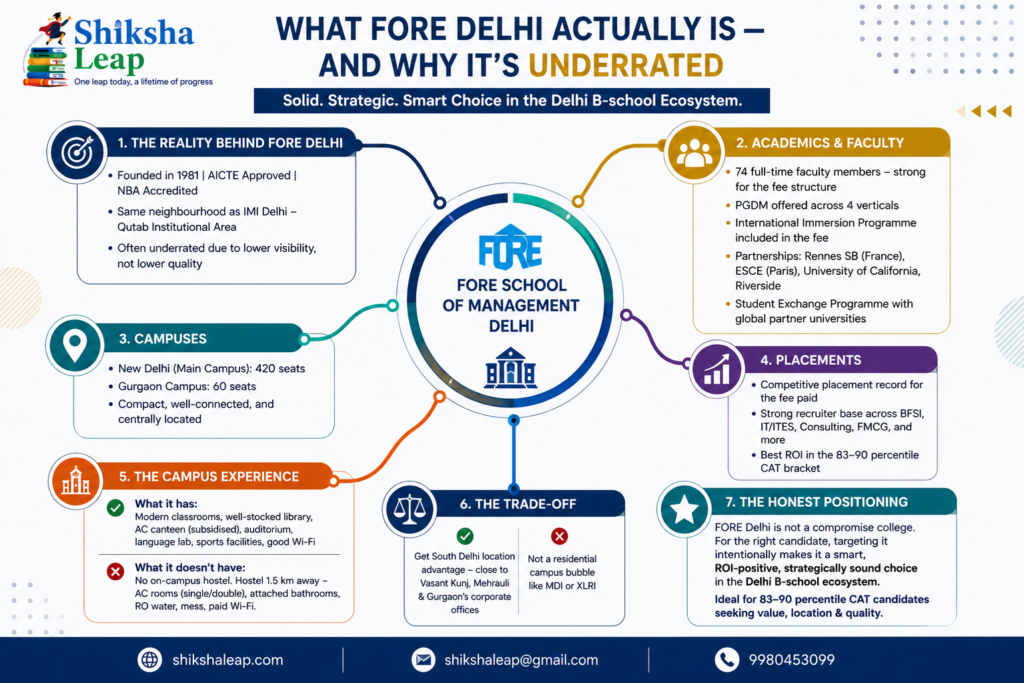
Here’s the thing about FORE Delhi that the rankings don’t quite capture: it’s a genuinely solid institution that suffers from a positioning problem. It sits in the same neighbourhood — literally and figuratively — as IMI Delhi. Both are in Qutab Institutional Area. Both were founded in 1981. Both have AICTE approval and NBA accreditation. And yet, because IMI gets marginally more search traffic and a slightly shinier digital presence, FORE sometimes ends up as an afterthought on applicants’ college lists.
It has two campuses — New Delhi (the main one, 420 seats) and Gurgaon (60 seats). Its PGDM programmes are offered across four verticals. And it has a placement track record that — while not at SPJIMR or XLRI levels — is competitive with similarly-priced institutions and genuinely strong for the fee paid.
The Best MBA for Entrepreneurs in India
Need Help with Your FORE Delhi Management Quota Admission?
Connect with ShikshaLeap today for expert guidance and personalized assistance to choose the course that best aligns with your career goals.
Call us at: +91-9980453099
Write to us at: shikshaleap@gmail.com
The FORE Delhi Campus: Small but Honestly Quite Good
Students who visit FORE Delhi for the first time are occasionally surprised by how green and calm the campus feels, given that it’s in the middle of one of Delhi’s most commercially active zones.
The main campus is in Qutab Institutional Area — the same block that houses IIT Delhi, JNU, and a cluster of South Delhi’s most prominent institutions. It’s not a sprawling 35-acre residential campus like MDI or XLRI. It’s compact, well-maintained, and very centrally located.
Best MBA Colleges in Delhi NCR 2026: Your Gateway to Leadership and Success
What the campus has: modern classrooms, a well-stocked library, a fully air-conditioned canteen with subsidised meals, an auditorium, a language lab, sports facilities, and good Wi-Fi. What it doesn’t have: an on-campus hostel. The hostel is 1.5 km away — fully air-conditioned, AC single and double occupancy rooms with attached bathrooms, RO water, mess service, and paid Wi-Fi. Functional and clean, but not the residential campus bubble you’d get at MDI or XLRI.
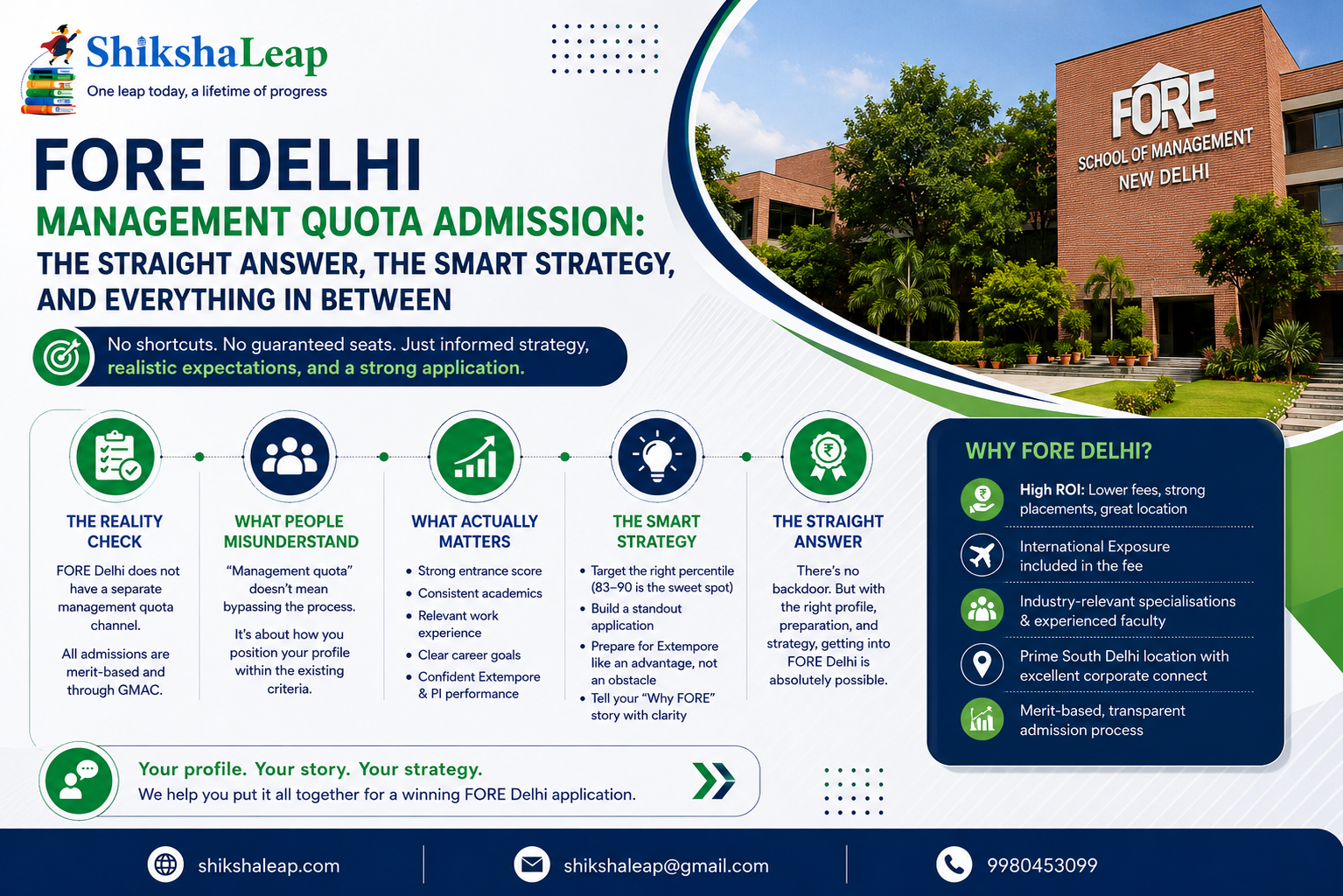
The FORE Delhi Management Quota Admission Question
Does FORE Delhi have a management quota?
No.
That’s about as unambiguous as institutional language gets. FORE Delhi was founded in 1981 as a non-profit institution. It’s accredited by NBA and SAQS, its PGDM is recognised as MBA-equivalent by AIU, and it has spent over four decades building a reputation on academic integrity. That’s not the profile of an institution running parallel donation-seat operations.
Now, there is a company-sponsored category — where candidates sponsored by a PSU or business house get considered with the backing of their organisation’s recommendation. That’s formal, disclosed, and requires you to download a specific form from the official website. It’s a category, not a quota. And it still involves the same extempore and PI process as everyone else.
Is IIFT Delhi Direct Admission 2026 Possible?
Four Programmes, One Campus, and the Choice You’ll Actually Have to Make
FORE Delhi offers four two-year PGDM programmes for the 2026–28 batch. They share similar eligibility criteria but have different focus areas, different sector placement strengths, and slightly different CAT cutoffs — which is important when you’re building a strategy.
PGDM (General Management): The flagship. 240 seats in New Delhi. Dual specialisation offered — you pick two from Marketing, Finance, Operations, HRM, Strategy, and Analytics. If you’re not yet certain which function you want to spend the next twenty years in, this gives you room to figure it out while you’re there. CAT/XAT cutoff: 85 percentile.
PGDM (International Business): For the globally inclined. 60 seats. IB must be one of your two specialisations; you pick the second. If you want MNC roles, export-import functions, or global management tracks, this is a more focused credential than the general PGDM. CAT/XAT cutoff: 75 percentile — meaningfully more accessible.
PGDM (Financial Management): Designed for corporate finance, banking, investment management, and equity research careers. Also 60 seats. If BFSI is your specific target and you want a programme built around that rather than a general PGDM that happens to have Finance as an elective, this is worth considering. CAT/XAT cutoff: 75 percentile.
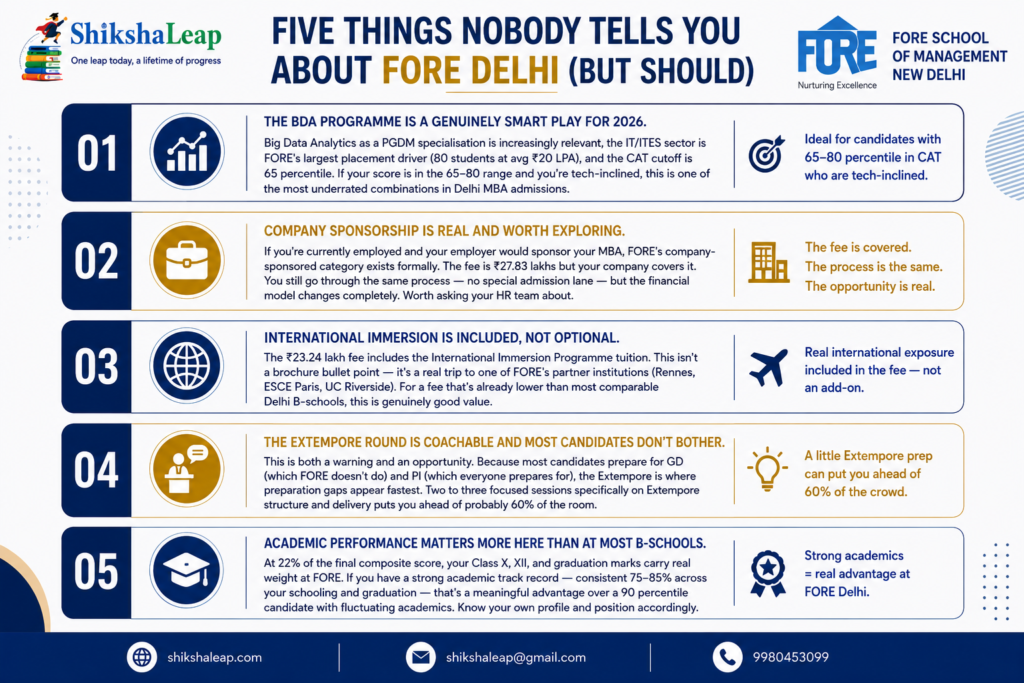
PGDM (Big Data Analytics): The newest and most sector-forward of the four. 120 seats across Delhi and Gurgaon campuses. BDA must be one of your specialisations. Data and analytics roles, product management, tech consulting — if that’s your lane, this programme is increasingly relevant. And the CAT cutoff here? 65 percentile. Genuinely the most accessible entry point in FORE’s portfolio.
Is IMI Delhi Direct Admission possible in 2026?
One thing to note that FORE’s own FAQ confirms: you can apply to multiple programmes. If you’re at 82 percentile, don’t just write off FORE General — apply for IB and FM too, where the bar is lower and the outcomes are still strong.
FORE Delhi Fees, Cutoffs, and Scholarships — No Fluff
CAT and XAT Cutoffs for FORE Delhi 2026
| Programme | CAT Cutoff | XAT Cutoff | GMAT |
| PGDM (General) | 85 percentile | 87 percentile | 650+ |
| PGDM (IB) | 75 percentile | 75 percentile | 650+ |
| PGDM (FM) | 75 percentile | 75 percentile | 650+ |
| PGDM (BDA) | 65 percentile | 65 percentile | 600+ |
No sectional cutoffs. One cutoff applies across all candidate categories — FORE explicitly follows a no-reservation policy at the cutoff stage. That’s refreshingly straightforward.
FORE Delhi Management Quota Fees
- Self-sponsored candidates: ₹23.24 lakhs (total, inclusive of tuition, International Immersion Programme tuition, exam fees, library, IT services, extracurricular activities)
- Company-sponsored candidates: ₹27.83 lakhs
- Application fee: ₹1,770 (including 18% GST) per programme
- Hostel: Located 1.5 km from campus; fully air-conditioned, single and double occupancy rooms with attached bathrooms; approximately ₹3 lakh/year additional
Total cost of FORE Delhi PGDM (2026–28), all-in: Tuition (₹23.24L) + Hostel (₹6L for two years) + personal expenses ≈ ₹28–30 lakhs
Now the scholarship story, which most people skip reading and then kick themselves for later:
FORE offers a Means-cum-Merit Scholarship covering tuition fee waiver for eligible students in both first and second year across all four PGDM programmes. Beyond this, there’s a 10% tuition fee waiver for students domiciled in J&K, Ladakh, and the eight North-Eastern states of India (Arunachal Pradesh, Assam, Manipur, Meghalaya, Mizoram, Nagaland, Tripura, Sikkim). Merit-based scholarships of ₹1 lakh are also awarded to meritorious students.
How to get Direct Admission in LBSIM Delhi 2026?
If you think you might qualify for any of these, ask explicitly during the admissions process. Scholarships are not always proactively offered — they’re applied for. We help ShikshaLeap students identify and apply for every legitimate scholarship they’re eligible for, because ₹1 lakh is ₹1 lakh.
Need Help with Your FORE Delhi Management Quota Admission?
Connect with ShikshaLeap today for expert guidance and personalized assistance to choose the course that best aligns with your career goals.
Call us at: +91-9980453099
Write to us at: shikshaleap@gmail.com
FORE Delhi Admission Process: An Extempore Round That Will Either Terrify You or Be Your Secret Weapon
Here’s where FORE Delhi gets genuinely interesting — and genuinely different from most B-schools on a comparable list.
At ShikshaLeap, this is one of the specific things we train for. Not generically — with actual timed practice rounds, feedback on structure and delivery, and the kind of repetition that turns a terrifying exercise into something you can genuinely look forward to.
How to get Direct Admission in FORE Delhi through Management Quota and NRI Quota?
If the Extempore sounds like your nightmare, call us at 9980453099. Six sessions with us and it’ll start sounding like your edge.
FORE Delhi Placement Reality: Honest Numbers, Honest Context
Let’s talk about placements without the promotional gloss that most B-school content applies like a coat of paint.
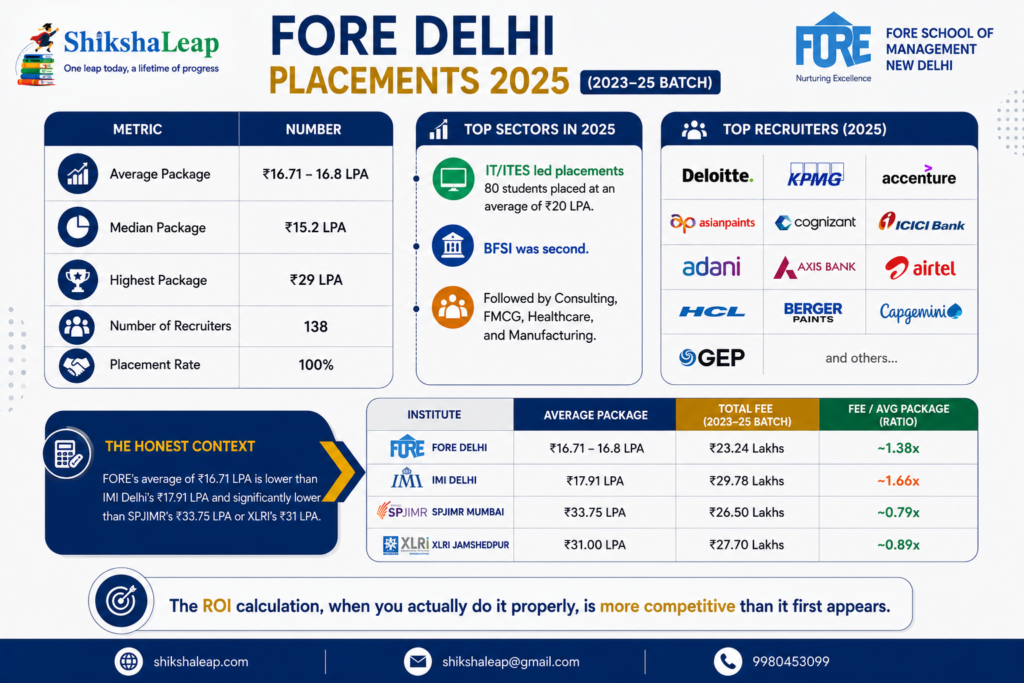
Here’s a way to think about it: if you’re choosing between FORE Delhi and IMI Delhi — two institutions in the same postcode — IMI Delhi gets you higher average outcomes but costs about ₹6.5 lakhs more in fees and requires a 90–95 CAT percentile vs FORE’s 85. For a candidate at 84 percentile with a strong profile and Delhi-NCR career goals, FORE Delhi isn’t the consolation prize. It’s the right target.
For careers specifically in IT/ITES consulting, BFSI, or FMCG marketing in the Delhi-NCR region, the FORE School of Management maintains a highly active and relevant recruiter base. Consequently, having global firms like Deloitte and KPMG actively recruit from a campus with a ₹23 lakh fee and an 85th percentile CAT cutoff offers students a genuinely strong value proposition.
MDI Gurgaon Direct Admission 2026: Is Management Quota an Option?
What Actually Gets You Into FORE Delhi: The Practical Checklist
Since the management quota route is definitively off the table, here’s what the actual path looks like:
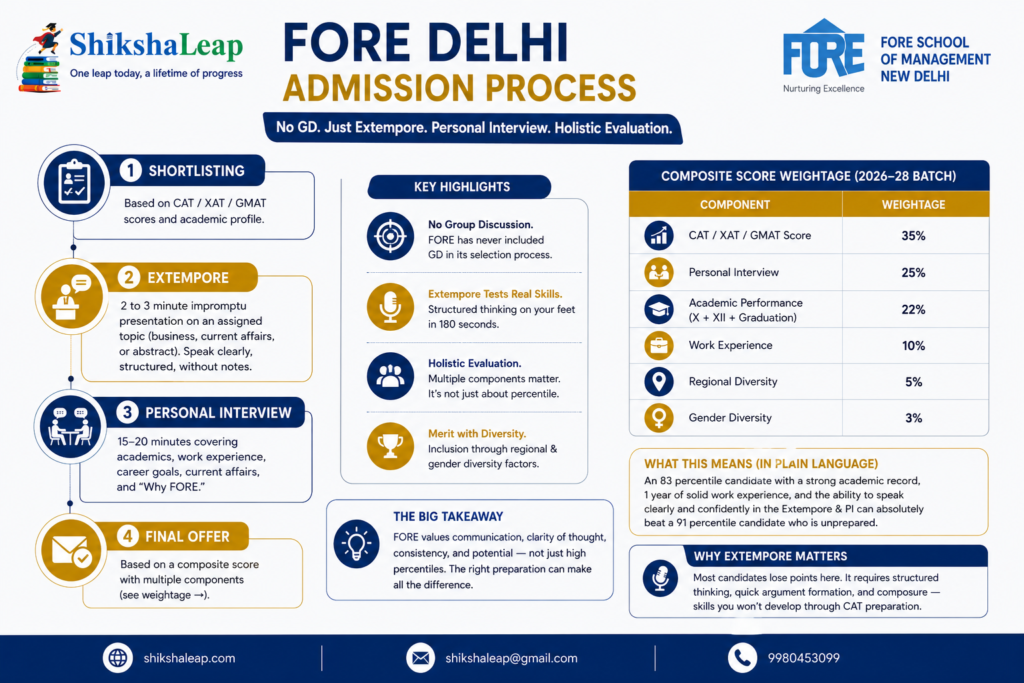
Step 1 — Clear the CAT, XAT, or GMAT bar: For General PGDM, aim for 85+ in CAT or 87+ in XAT. For IB and FM, 75+. For BDA, 65+. These are qualifying thresholds, not rankings — FORE doesn’t rank candidates purely by exam score. Once you’re above the bar, the composite score takes over.
Step 2 — Apply online through the official admissions portal: FORE’s application is online only, through https://admissions.fsm.ac.in. The application fee is ₹1,770 per programme. You can apply to multiple programmes and should — strategically selecting the combination that maximises your chances based on your score.
Step 3 — Shortlisting: Shortlisting is based on your exam score and overall profile. FORE explicitly says it encourages diversity — gender, academic background, work experience. Non-engineers applying with a consistent academic record often find FORE’s shortlisting more welcoming than institutes that heavily weight engineering backgrounds.
Step 4 — Extempore + Personal Interview: This is where the real work happens. The Extempore (2–3 minutes, impromptu topic) and PI (15–20 minutes) together account for 35% of your final composite score. This is not a formality. Candidates who don’t prepare for this specific format regularly lose offers to candidates with lower exam scores who walked in confident and clear.
Step 5 — Final Composite Score: Exam score (35%) + PI (25%) + academics (22%) + work experience (10%) + regional and gender diversity (8%) = your position on the final merit list. Knowing this breakdown should change how you prepare — because 65% of your final score has nothing to do with your CAT percentile.
Five Things Nobody Tells You About FORE Delhi
FORE Delhi vs IMT Ghaziabad vs LBSIM Delhi: The ShikshaLeap Read
Since this question comes up on almost every call we get from aspirants in the 80–90 percentile CAT range, here’s our honest take:
| Parameter | FORE Delhi | IMT Ghaziabad | LBSIM Delhi |
| NIRF 2025 | #59 | ~#30 | Unranked |
| Accreditation | NBA, SAQS | AACSB, AMBA | NBA |
| CAT Cutoff | 85%ile (Gen) | 80–85%ile | 70–75%ile |
| Average Package 2025 | ₹16.71 LPA | ~₹13–15 LPA | ~₹10–12 LPA |
| Fee | ₹23.24 L | ~₹17–18 L | ~₹10–12 L |
| Location | South Delhi | Ghaziabad | Rohini, Delhi |
| Intl. Immersion | ✅ Included | Selective | ❌ |
Our honest read: FORE Delhi’s average placement is higher than both IMT Ghaziabad and LBSIM, and its South Delhi location carries a real career advantage. IMT Ghaziabad has stronger AACSB accreditation and lower fees — if budget is the primary constraint and location is flexible, it’s a legitimate competitor. LBSIM is a lower-fee option for candidates who don’t clear FORE’s cutoff or want to minimise debt exposure.
If FORE Delhi is within your CAT range, target it seriously rather than defaulting to it as a backup. The outcome difference between a strategically pursued FORE application and a lazily filed one is not small.
IMT Ghaziabad Admission 2026: Cutoffs, Fees, Placements & Direct Admission
Need Help with Your FORE Delhi Management Quota Admission?
Connect with ShikshaLeap today for expert guidance and personalized assistance to choose the course that best aligns with your career goals.
Call us at: +91-9980453099
Write to us at: shikshaleap@gmail.com
How ShikshaLeap Turns Your FORE Delhi Application Into an Offer?
We’re going to be honest about one more thing: FORE Delhi’s relatively accessible cutoff is also what makes the selection process more competitive at the shortlisting stage. More candidates qualify for the interview than at IIM B. That means the Extempore and PI carry even more weight in distinguishing the final offer-holders from the rest.
Here’s exactly what we do with FORE aspirants:
- Profile evaluation and programme selection
- Application strategy
- Extempore coaching
- PI preparation
- Scholarship identification
The cost of proper preparation with us is fractional compared to the fee difference between getting into FORE Delhi and spending another year attempting CAT. More importantly, it’s fractional compared to the career value of starting your MBA in July 2026 rather than waiting until 2027 with nothing changed except more anxiety.
Admission in Faculty of Management Studies (FMS) Delhi 2026
Is FORE Delhi PGDM right fight for you?
FORE Delhi is a good college. Chosen deliberately, prepared for properly, it gives a Delhi-NCR career a genuinely solid foundation — especially in BFSI, IT consulting, and FMCG marketing. The management quota route doesn’t exist. The shortcut doesn’t exist. But the actual path in is more achievable than most 83–90 percentile candidates give themselves credit for.
If you have a score in that range, a profile worth presenting, and the willingness to put in two to three weeks of focused preparation for the Extempore and PI — FORE Delhi should not be the college you apply to as an afterthought. It should be the one you walk into knowing exactly why you’re there and what you’re going to say.
We can help you get to that point.
📞 Call ShikshaLeap at 9980453099 ✉️ Write to us at shikshaleap@gmail.com Let’s have a twenty-minute conversation about your profile, your score, and whether FORE Delhi is the right next move for you. No sales pitch. Just honest guidance. ShikshaLeap — One Leap Today. A Lifetime of Progress.
➡️ Start your FORE Delhi journey with confidence — Let ShikshaLeap guide you every step of the way!
ShikshaLeap wishes each and every Aspirant, best of Luck for your Journey! You already won the day to decide to go for it so let not anything stop you from achieving your goal and if you have any doubt regarding anything maybe it is the entrance exam, interview prep or profile building we are there as your Friend, Philosopher & Guide!
Let’s TALK @ 9980453099
FAQs About FORE Delhi PGDM Direct Admission
Q. Is there any management quota at FORE Delhi?
No. FORE’s official FAQ states this explicitly. Admissions are merit-based through CAT, XAT, or GMAT, followed by the Individual Assessment Process.
Q. Can I apply to FORE without CAT or XAT?
Yes — GMAT scores (valid from January 2024 to January 2026) are accepted. This is the NRI and international applicant route, as well as an option for Indian candidates who took the GMAT.
Q. What’s the difference between FORE’s four programmes?
General PGDM is the broadest (240 seats, dual specialisation). IB focuses on global business (75 percentile cutoff). FM focuses on finance and banking (75 percentile cutoff). BDA is analytics-focused and most accessible (65 percentile cutoff). All have the same base fee of ₹23.24 lakhs.
Q. Does work experience help at FORE?
Yes — it’s worth 10% of the final composite score. Even one year of quality professional experience is a meaningful differentiator, particularly in the PI.
Q. Is hostel available at FORE Delhi?
The hostel is 1.5 km from campus — not on-campus. AC rooms in single and double occupancy with attached bathrooms. Approximately ₹3 lakh/year additional cost beyond the programme fee.
Q. How should I prepare for the FORE Extempore?
Start by practising 2-minute structured speeches on current affairs topics. Use the Point–Evidence–Conclusion format. Record yourself. Get feedback. Do at least 10 timed practice rounds before the actual Extempore. Or call ShikshaLeap and we’ll run you through the whole thing properly.
Also read about:
- ISB Hyderabad Direct Admission 2026: Indian School of Business – The Architecture of Excellence
- MDI Gurgaon Direct Admission 2026: Is Management Quota an Option?
- SP Jain Mumbai Direct Admission 2026: Exploring Management & NRI Quota Paths
- XLRI Delhi Management Quota Admission 2026: Let’s Have the Honest Conversation Nobody Else Will
- IMI Delhi Management Quota Admission 2026: What’s Real, What’s a Myth, and What Actually Gets You In
If you’re planning to pursue Engineering and want to explore top Engineering colleges, courses, and admission options, Visit: Direct Admission to Top Private Engineering Colleges in India | Shiksha Tech
OR
If you’re planning to pursue MBBS and want to explore Top MBBS Colleges, courses, and admission options, Visit: Direct Admission to Top Medical Colleges in India | Dr. Shiksha